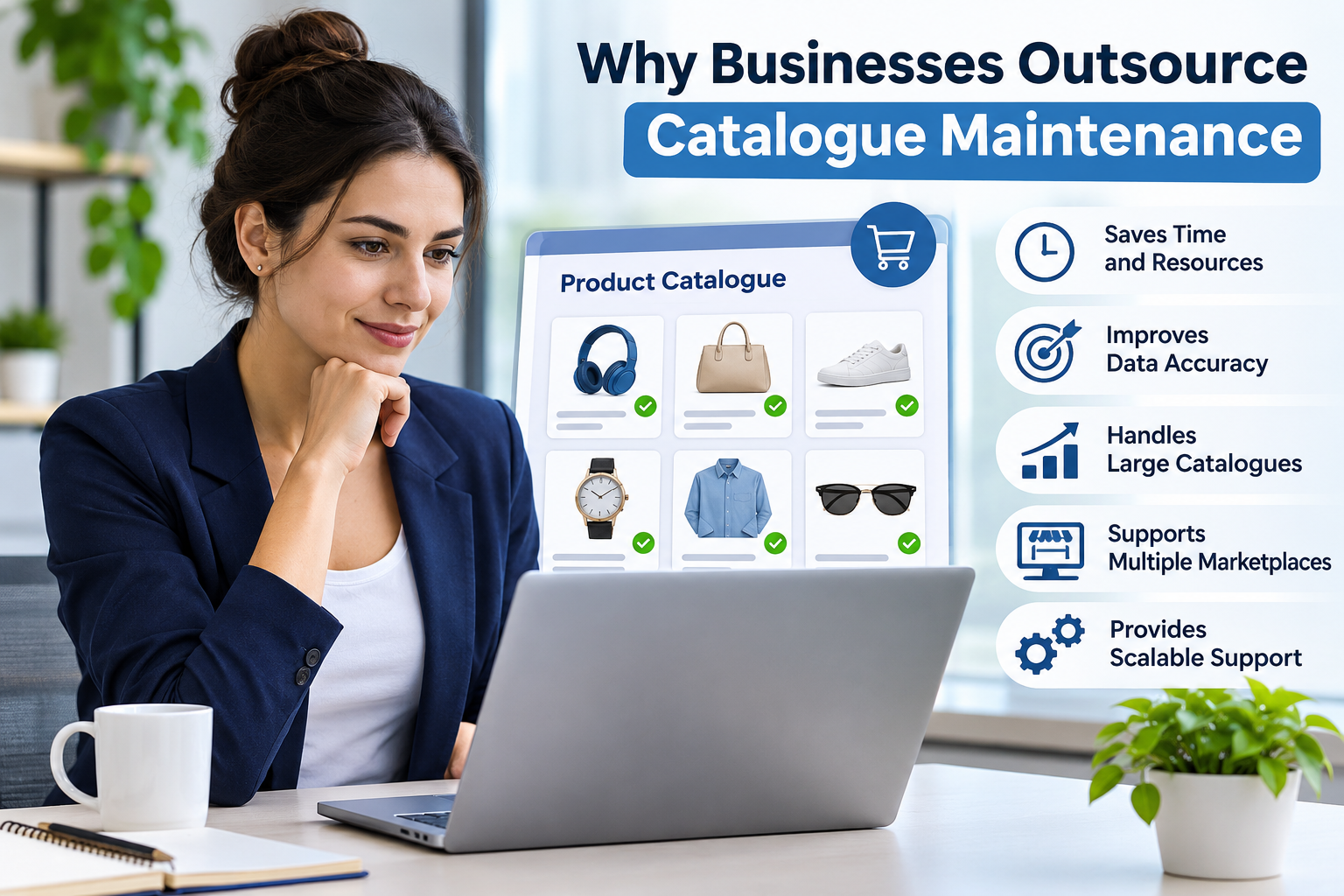
Why Businesses Outsource Catalogue Maintenance
25 Nov 2026

Managing an eCommerce catalogue is not a one-time job. Products change, suppliers introduce new specifications, prices are revised, stock availability fluctuates and marketplaces regularly require updates to product information.
For businesses managing hundreds or thousands of products, keeping everything accurate can become a substantial operational responsibility. An update that takes only a few minutes for one product can require hours of work when the same changes need to be applied across multiple product categories and sales channels.
This is one reason many retailers, wholesalers, manufacturers and online sellers choose to outsource catalogue maintenance.
Instead of assigning every product update to their internal employees, businesses work with external catalogue management teams to handle repetitive product data tasks. This arrangement can provide additional processing capacity, support consistent data management and help internal teams concentrate on more important business activities.
But outsourcing is not automatically the right decision for every company. Understanding its practical advantages, limitations and implementation requirements can help businesses decide whether it makes sense for their operations.
Catalogue maintenance refers to the ongoing process of reviewing, updating, correcting and organising product information across online stores, marketplaces and product databases.
It covers much more than adding new products. Existing product records also need attention whenever business information changes.
Typical catalogue maintenance activities include:
For example, an online furniture retailer might receive updated dimensions, materials and product images from a manufacturer. These changes need to be reflected in the retailer’s product database and relevant online listings.
Without a structured maintenance process, different versions of the same product information can remain active across sales channels.
Businesses looking to organise these activities can explore professional catalog updating and maintenance services.
There are several operational reasons behind this decision. The most important ones are usually related to workload, data accuracy, available resources and the complexity of managing products across multiple platforms.
A small online store might manage a few hundred products without needing dedicated catalogue support.
However, the workload changes considerably when a business expands its product range.
Consider a retailer managing 8,000 products across different categories. Every product may have multiple information fields, including descriptions, specifications, images, SKUs, prices and variations.
Even relatively small updates can become time-consuming when applied across thousands of records.
The workload increases further when:
Outsourcing allows businesses to delegate these repetitive tasks to a team that can work through defined instructions and processing schedules.
This is particularly useful when internal employees are spending too much time maintaining spreadsheets and updating product records instead of managing core business activities.
Incorrect product information can create problems throughout an eCommerce operation.
A product might have the wrong dimensions, an incomplete description, an incorrect SKU or an image belonging to a different variation.
These mistakes can confuse customers and create additional work for customer support and fulfilment teams.
Outsourcing can introduce a more structured approach to product data processing.
An experienced catalogue team can work according to predefined guidelines covering:
For example, a retailer receiving product specifications from several suppliers may find that each supplier uses a different format.
One supplier records dimensions in centimetres, while another uses inches. Product colours may also be described differently across supplier files.
A standardised workflow helps bring this information into a consistent structure before it is added to the catalogue.
Businesses dealing with incomplete or inconsistent product records may also benefit from dedicated product data cleansing services.
Catalogue maintenance often involves repetitive activities that require attention to detail but do not necessarily need to be handled by senior employees.
For example, an eCommerce manager might spend several hours every week:
These activities are necessary, but they can take time away from merchandising, supplier relationships, marketing campaigns and business planning.
By outsourcing suitable catalogue tasks, businesses can distribute responsibilities more effectively.
Internal employees can retain responsibility for product decisions, pricing approvals and merchandising strategy, while an external team handles routine data processing and catalogue updates.
The objective is not to replace internal knowledge. It is to make better use of the time and expertise already available within the business.
Selling through several channels creates another layer of catalogue management work.
A retailer might operate:
Although the core product information may be the same, each platform can have different listing fields, category structures, image requirements and product data rules.
A product description suitable for an independent online store might need to be reorganised for a marketplace listing.
Similarly, product attributes may need mapping to different category-specific fields.
An outsourced catalogue team can help process product information for these different platforms while following the relevant channel requirements.
This is especially useful for businesses expanding into new marketplaces or managing a large product assortment across several online stores.
However, outsourcing does not remove the need for platform-specific validation. Businesses should still check that submitted information meets each marketplace’s current requirements.
Expanding a catalogue often increases the amount of operational work required.
A business introducing 2,000 additional products may suddenly need more resources for data collection, product entry, image management, attribute mapping and quality checking.
Hiring additional permanent employees may not always be the most practical solution, particularly when the increased workload is related to a temporary product launch or seasonal requirement.
Outsourcing provides another way to obtain additional processing capacity.
Depending on the agreement, businesses can arrange support for:
This gives companies more flexibility when their catalogue workload changes.
It is important to compare the complete cost of outsourcing with the cost of internal recruitment, training, software, supervision and quality control rather than comparing hourly rates alone.
Product information changes throughout the year.
Manufacturers release revised specifications, suppliers change product availability, retailers introduce new prices and businesses discontinue older products.
If updates are delayed, customers may see information that no longer reflects the actual product or its availability.
For businesses managing multiple product categories, maintaining a regular update schedule can be difficult without clearly assigned responsibilities.
An outsourced maintenance arrangement can help establish recurring workflows for processing approved changes.
For example:
| Catalogue Update | Possible Maintenance Activity |
|---|---|
| New supplier information | Review and update product records |
| Revised specifications | Correct existing product attributes |
| New product images | Replace or organise product images |
| Price changes | Apply approved pricing updates |
| Discontinued products | Update product status or remove listings |
| Stock changes | Process approved availability updates |
| New product variations | Update sizes, colours and related SKUs |
The business should provide reliable source information and define which changes require internal approval.
A catalogue is easier to manage when products follow a logical structure.
Incorrect categories, inconsistent attributes, missing specifications and duplicate records can make it harder for customers to find suitable products.
For example, a retailer selling electrical equipment might have products assigned to broad categories without properly distinguishing voltage, compatibility, product type or technical specifications.
This can make filtering and product comparison less useful.
An external catalogue team can help organise product information using predefined classification rules and attribute structures.
Tasks may include:
These activities support better catalogue organisation and can make product information more useful to customers.
They do not guarantee higher search rankings or conversions, but they help address underlying product data problems that can affect the shopping experience.
Many businesses experience significant changes in catalogue workload during particular periods.
Retailers may introduce Christmas collections, summer products, back-to-school ranges or promotional product bundles.
Wholesalers and distributors may receive updated supplier catalogues containing hundreds of new products.
These activities often require a large amount of product data processing within a limited timeframe.
Maintaining sufficient internal capacity throughout the year can be difficult when workload fluctuates.
An outsourced team can provide additional support during planned busy periods, provided the scope, deadlines and quality requirements are agreed in advance.
For example, a retailer could retain product selection and promotional planning internally while delegating product data entry, image matching, attribute updates and listing preparation.
This arrangement can help businesses prepare large product ranges without putting every task onto their existing employees.
Not every catalogue-related responsibility needs to be delegated.
A practical approach is to separate repetitive processing activities from decisions that require detailed business knowledge or management approval.
| Task | Outsourcing Suitability |
|---|---|
| Product data entry | Highly suitable |
| Product description formatting | Suitable |
| Product attribute updates | Highly suitable |
| SKU and identifier updates | Suitable with clear rules |
| Image matching and organisation | Highly suitable |
| Category assignment | Suitable with defined guidelines |
| Duplicate record identification | Highly suitable |
| Bulk catalogue updates | Highly suitable with testing |
| Price changes | Suitable with approved source data |
| Inventory updates | Suitable with reliable instructions and controls |
| Product selection strategy | Usually retain internally |
| Pricing strategy | Retain internally |
| Brand positioning | Retain internally |
| Final commercial approvals | Retain internally |
The most effective arrangement is often a combination of internal oversight and external execution.
Businesses retain control over important decisions while outsourcing the time-consuming activities involved in maintaining product information.
Both approaches can work. The right choice depends on product volume, update frequency, available employees and the complexity of the catalogue.
| Business Requirement | In-House Maintenance | Outsourced Maintenance |
|---|---|---|
| Small product catalogue | Often practical | May be unnecessary |
| Large product database | Requires sufficient internal resources | Additional processing capacity |
| Frequent product updates | Internal team handles recurring workload | External team can process assigned updates |
| Multiple marketplaces | Requires platform-specific expertise | Can provide additional listing support |
| Seasonal workload | May require temporary staffing | Flexible project-based support |
| Data cleansing | Internal resources required | Can be delegated |
| Quality control | Managed internally | Requires agreed review procedures |
| Business oversight | Direct internal control | Internal oversight remains important |
A hybrid arrangement is often worth considering.
For example, an online retailer can keep its product managers, merchandising team and pricing approvals in-house while outsourcing routine product information updates and catalogue processing.
This approach provides additional support without transferring important commercial decisions to an external provider.
Choosing a provider requires more than comparing prices.
Product information is an important business asset, so companies should understand how an outsourcing partner will process, protect and deliver their data.
Ask whether the provider has experience working with your product categories, catalogue formats and target platforms.
Experience with Shopify does not automatically mean a provider understands every requirement associated with Amazon or Walmart Marketplace.
Look for relevant operational knowledge rather than general data entry experience alone.
Ask how product information is checked before delivery.
A suitable workflow should include checks for:
Agree on measurable quality requirements before the project begins.
Provide a product data style guide, sample records, naming conventions and category-specific attribute requirements.
The more clearly the work is defined, the easier it becomes to maintain consistent results.
External teams may need access to spreadsheets, databases, PIM systems or eCommerce platforms.
Before sharing access, establish:
Avoid sharing unnecessary administrator credentials.
Rather than immediately transferring the entire catalogue, begin with a manageable group of products.
Use the trial to assess:
Once the workflow is working properly, gradually increase the volume.
Outsourcing should produce measurable operational improvements.
Businesses should agree on performance indicators that reflect the actual work being completed.
Useful measurements include:
| Performance Indicator | What It Measures |
|---|---|
| Data accuracy rate | Percentage of reviewed records meeting agreed requirements |
| Attribute completeness | Percentage of required product fields completed |
| Update turnaround time | Time required to process assigned updates |
| Duplicate record rate | Frequency of duplicate product records |
| Error correction rate | Number of records requiring corrections |
| Listing completion rate | Percentage of assigned listings completed |
| On-time delivery | Work completed within agreed deadlines |
| Rework volume | Amount of work requiring repeated processing |
For example, if a team is responsible for updating 1,000 product records, the business should not evaluate performance only by the number of records completed.
It should also review whether the information was accurate, correctly formatted and entered into the appropriate product records.
Quality and productivity need to be considered together.
Outsourcing may be worth considering when:
On the other hand, a small business with a limited product range and occasional updates may find that an internal employee can manage the work more efficiently.
The decision should be based on actual workload, data complexity, operational costs and the availability of suitable internal resources.
For businesses managing large product databases, having a dependable catalogue processing workflow can make ongoing operations easier to organise.
India Data Entry Services provides catalogue maintenance and eCommerce data support for businesses that need assistance with product information updates, bulk catalogue processing, product attributes, categories, images, pricing, inventory information and SKU management.
Its catalog management services cover product information organisation and ongoing catalogue processing across eCommerce stores and marketplaces.
The support can be structured around one-time assignments or recurring maintenance requirements, depending on the business’s product volume and workflow.
Companies can also combine catalogue maintenance with product data cleansing when existing records contain duplicate, incomplete or inconsistent information.
The important step is to establish clear project requirements, source data, quality standards and access permissions before processing begins.
Outsourcing catalogue maintenance is not simply about transferring product data entry work to another company. It is about finding a practical way to manage an ongoing operational responsibility without putting unnecessary pressure on internal resources.
For businesses with large product ranges, frequent supplier updates or multiple sales channels, external catalogue support can provide additional processing capacity and help maintain consistent product information.
However, successful outsourcing depends on the quality of the workflow, clear instructions, reliable source data and appropriate quality checks.
Businesses should begin by identifying which catalogue activities consume the most time, which tasks can be standardised and which decisions must remain under internal control.
With the right arrangement, outsourcing can become a useful part of a long-term eCommerce operations strategy.
25 Nov 2026

24 Nov 2026
23 Nov 2026