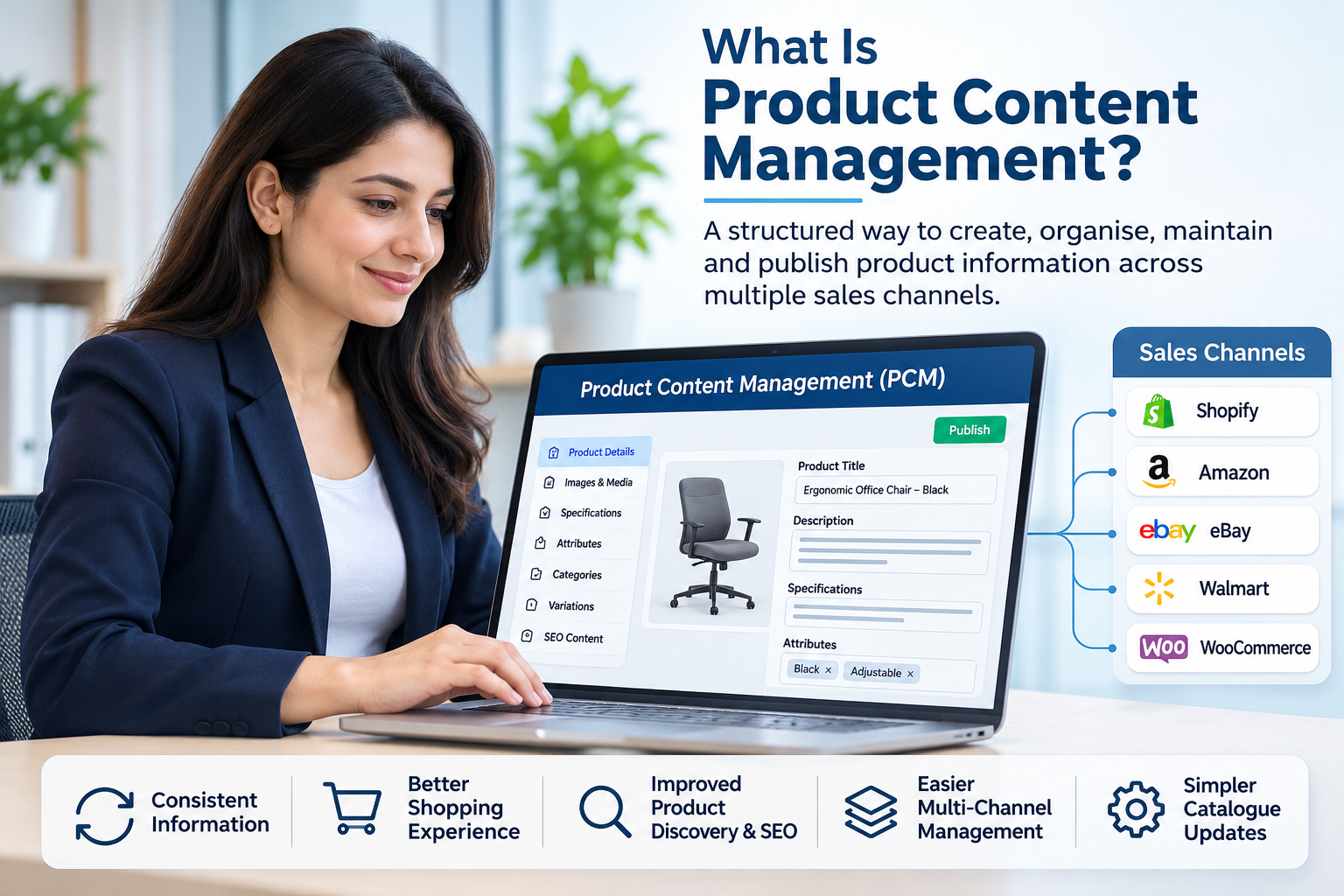
What is Product Content Management?
23 Nov 2026

Managing product information becomes increasingly complicated as an eCommerce business grows. A retailer might start with a few dozen products, but as the catalogue expands to thousands of SKUs, maintaining accurate descriptions, images, specifications, categories and product variations becomes a significant operational responsibility.
The challenge becomes even greater when products are sold through multiple channels. Information that appears correctly on an online store might be incomplete on Amazon, inconsistent on eBay or outdated in a supplier catalogue.
This is where product content management becomes important.
It provides a structured way to create, organise, review, update and distribute product information so customers receive accurate and consistent details wherever they discover a product.
For eCommerce managers, retailers, manufacturers and marketplace sellers, understanding this process can help improve catalogue quality, simplify product updates and make large product ranges easier to manage.
Product Content Management (PCM) is the process of creating, organising, maintaining, enriching and publishing all the content associated with a product across digital sales channels.
It covers more than writing product descriptions. It includes the information customers read, the images they view, the specifications they compare and the attributes that help them find suitable products.
A typical product content record may include:
For example, consider an online retailer selling office furniture.
A product page for an office chair might contain its name, material, colour, dimensions, adjustable features, weight capacity, assembly instructions and product photographs.
Product content management ensures that these details are properly organised, reviewed and updated before being published.
It also helps maintain consistent product information across the company’s website, marketplaces, product catalogues and other digital platforms.
Product information influences how customers discover, compare and evaluate products.
When information is missing or inconsistent, customers may struggle to understand what they are purchasing. This can create unnecessary questions, reduce confidence and contribute to avoidable returns.
A structured product content management process addresses several operational challenges.
Businesses frequently receive product information from different suppliers, manufacturers and distributors.
One supplier might provide dimensions in centimetres, while another uses inches. Product colours may have different names, and technical specifications might follow different formats.
Without standardisation, the same product can appear differently across sales channels.
Product content management establishes common formatting rules and ensures that important information follows an agreed structure.
Customers want to understand whether a product meets their requirements before purchasing.
A furniture buyer may need accurate dimensions, material details and assembly instructions. Someone purchasing electronic equipment may want processor specifications, connectivity information and compatibility details.
Providing this information in an organised format makes product comparisons easier.
For additional guidance, see our article on why product specifications matter in eCommerce.
Search engines and shopping platforms use product information to understand what a product offers.
Clear titles, relevant descriptions, accurate categories and structured attributes help make product information easier to interpret.
However, adding keywords to descriptions alone is not a complete product optimisation strategy.
Businesses also need to maintain useful specifications, appropriate product categories, descriptive image information and consistent product attributes.
Shopify’s product documentation explains how titles, descriptions, media, categories, tags and other product details contribute to product organisation and presentation.
Selling through several platforms creates additional content management requirements.
A business might maintain products on:
Each platform can have different content fields, category structures and listing requirements.
A well-organised product content process helps businesses maintain consistent product facts while adapting the presentation to each channel.
Product information changes regularly.
Manufacturers introduce new models, suppliers revise specifications, retailers change product descriptions and businesses update images or packaging details.
A structured process makes it easier to identify which records need updating and ensure that changes are reflected in the relevant sales channels.
Product content management covers several connected activities. Each contributes to the quality and usability of the product catalogue.
| Component | What It Involves |
|---|---|
| Product titles | Creating clear and consistent product names. |
| Descriptions | Writing informative product content. |
| Specifications | Organising dimensions, materials and technical details. |
| Attributes | Managing colour, size, brand and product characteristics. |
| Images and media | Organising product photographs, videos and related files. |
| Categories | Assigning products to appropriate categories. |
| Variations | Managing sizes, colours, models and other options. |
| SEO content | Preparing relevant titles, descriptions and image alt text. |
| Content updates | Maintaining accurate information over time. |
Product titles help customers identify products, while descriptions explain their features, benefits and intended uses.
For example, a basic supplier title such as “Office Chair Model 450” might not provide enough information for customers.
A more descriptive title could be:
Ergonomic Adjustable Office Chair with Mesh Back – Black
The exact format should follow the requirements of the business and the destination platform.
Descriptions should explain relevant features without adding unsupported claims.
Attributes are structured details that describe individual product characteristics.
For an apparel catalogue, these might include:
For an electronics catalogue, they might include:
Using category-specific attributes makes product information easier to organise and filter.
Product images play an important role in online shopping because customers cannot physically inspect items before purchasing.
Image management involves associating the correct images with the relevant products and variations.
Typical activities include:
Some businesses also use product videos, 360-degree views and 3D models.
Shopify supports product media such as images, videos and 3D models within its product management environment.
A reliable process should cover the entire journey from collecting product information to publishing and maintaining it.
The following workflow provides a practical starting point.
The first step is gathering information from reliable sources.
These may include:
The original source should be retained wherever possible so that product information can be checked when discrepancies appear.
Avoid filling missing specifications with assumptions.
Before processing a large catalogue, define which fields are required for each product category.
For example, a furniture retailer might use the following structure:
| Field | Example |
|---|---|
| Product Name | Wooden Dining Table |
| Material | Solid Oak |
| Colour | Natural Oak |
| Length | 180 cm |
| Width | 90 cm |
| Height | 75 cm |
| Seating Capacity | 6 People |
| Assembly Required | Yes |
An electronics retailer would require a different template.
Defining these structures in advance prevents inconsistent product records and reduces the amount of correction required later.
Raw supplier information is not always suitable for direct publication.
It may contain abbreviations, incomplete descriptions, inconsistent formatting or technical information that needs organising.
Content enrichment involves making the available information more complete and useful.
This can include:
AI tools can assist with repetitive content creation, particularly when processing large product catalogues.
However, generated content should be reviewed against the original product information. AI should not introduce unverified materials, compatibility claims, performance figures or product benefits.
Quality control should take place before product content reaches customers.
A practical review should check:
For large catalogues, automated validation rules can identify common problems, while manual checks can review information that requires human judgement.
Once the content is approved, it can be uploaded to the relevant eCommerce platform or marketplace.
The publishing process may involve importing CSV files, using platform administration tools, updating product records through APIs or working with a PIM system.
Field mapping is particularly important.
For example, an internal product database might use the field name “Product Weight”, while the destination marketplace uses “Item Weight”.
The correct information must reach the correct destination field.
Publishing a product is not the final stage.
Businesses need a maintenance process for:
Regular reviews help prevent outdated information from remaining on live product pages.
Product Content Management and Product Information Management are closely related, but they are not identical.
Product Content Management describes the processes and activities involved in creating, managing and publishing product content.
Product Information Management (PIM) refers to the centralised management of product information, commonly supported by dedicated software.
A PIM system can help businesses organise product records, maintain structured attributes, manage content workflows and distribute product information across different channels.
| Comparison | Product Content Management | Product Information Management |
|---|---|---|
| Main focus | Product content creation and maintenance | Centralised product information management |
| Main activities | Writing, editing, enriching and publishing | Collecting, structuring, storing and distributing data |
| Software requirement | Can use spreadsheets, platforms or specialised tools | Often uses dedicated PIM software |
| Content workflows | Content-focused processes | Broader information and data workflows |
| Main objective | Maintain useful product content | Maintain organised product information across systems |
A small retailer managing a limited catalogue may be able to handle product content through its eCommerce platform and spreadsheets.
A manufacturer distributing thousands of products across multiple retailers may benefit from a dedicated PIM solution.
The important point is that PIM software supports product content management, but purchasing a PIM system does not automatically ensure accurate product information.
The business still needs clear data standards, content guidelines, quality checks and defined responsibilities.
These terms are also frequently used together.
Catalogue management focuses on organising and maintaining the overall product catalogue.
Product content management focuses more specifically on the information and media associated with individual products.
For example, catalogue management may involve:
Product content management may involve:
In practice, the two activities overlap considerably.
Businesses managing large product ranges usually need both.
Even businesses with established eCommerce operations can experience product content problems.
Different suppliers often provide product details in different formats.
One file may contain complete technical specifications, while another includes only product names, prices and basic descriptions.
Practical solution: Establish standard product templates and define acceptable formats for each field.
Duplicate records can create confusion in inventory management, product publishing and catalogue maintenance.
Practical solution: Use unique product identifiers, SKU validation and duplicate detection procedures.
Missing sizes, materials, dimensions or technical specifications can make products harder to compare.
Practical solution: Define mandatory attributes for every product category and review missing fields before publication.
Product descriptions may no longer match the current model, packaging or available features.
Practical solution: Create a content review schedule and establish a process for receiving supplier updates.
A product may have different descriptions, specifications or images across multiple sales channels.
Practical solution: Maintain a trusted source of product information and establish channel-specific publishing rules.
Businesses can improve their product content operations by introducing a few practical controls.
1. Maintain a central product information source.
Keep a reliable master record for core product information. Avoid managing disconnected versions of the same catalogue without a clear update process.
2. Create category-specific templates.
Use different templates for clothing, electronics, furniture, industrial products and other categories.
3. Standardise product terminology.
Choose consistent naming conventions for colours, materials, dimensions, sizes and other attributes.
4. Separate verified facts from marketing content.
Technical specifications should be based on reliable source information. Marketing descriptions should communicate benefits without changing the underlying product facts.
5. Introduce quality assurance checks.
Use automated validation where possible and manual review for complex or sensitive product information.
6. Adapt content to individual platforms.
Maintain consistent product facts while following the formatting and listing requirements of each destination.
7. Review catalogue content regularly.
Schedule updates to identify outdated descriptions, missing attributes, incorrect images and discontinued products.
8. Assign clear responsibilities.
Define who collects supplier information, who prepares content, who approves changes and who publishes the final product records.
The right approach depends on catalogue size, update frequency, product complexity and available resources.
| Approach | Best Suited For | Main Consideration |
|---|---|---|
| Manual management | Small product catalogues | Becomes difficult as volume increases |
| Automation | Repetitive and structured tasks | Requires accurate rules and reliable source data |
| Internal team | Businesses needing direct operational control | Requires ongoing staffing and supervision |
| Outsourcing | Large catalogues and recurring processing work | Requires clear instructions and quality standards |
| Hybrid approach | Growing multi-channel businesses | Needs effective coordination |
Automation works particularly well for repetitive activities such as importing structured files, mapping fields, applying standard formatting and identifying missing values.
However, it may not resolve unclear supplier information, conflicting specifications or complex product descriptions without additional review.
Internal teams are useful when product decisions require close coordination with merchandising, compliance or technical departments.
Outsourcing can be practical when businesses have substantial volumes of repetitive product content work or need additional processing capacity without expanding their permanent team.
For example, a retailer launching 3,000 new products may outsource data preparation, content formatting, attribute entry and catalogue updates while keeping product approvals and merchandising decisions within its own team.
Managing product content requires consistent attention to detail, especially when businesses work with large product catalogues and several sales channels.
India Data Entry Services provides product content and catalogue support for businesses that need help processing, organising and maintaining product information.
Depending on project requirements, support can include:
Businesses can also explore catalogue content management services for structured product content processing.
For organisations managing product information from multiple sources, product data management services can support data collection, processing, standardisation and ongoing maintenance.
AI-assisted content creation may also be useful when large numbers of product descriptions need to be prepared or refreshed. The important step is ensuring that generated content remains consistent with verified product information.
Businesses can explore AI product description writing support for these requirements.
For sellers operating across several marketplaces, marketplace catalogue management can help with product additions, updates, attributes, images and listing maintenance.
The workflow can be arranged around the client’s existing templates, product data sources, platform requirements and quality standards.
Product content management is an essential part of running a well-organised eCommerce operation.
It involves much more than writing descriptions or uploading photographs. It covers the complete process of collecting, structuring, enriching, reviewing, publishing and maintaining product information.
For growing businesses, a consistent approach helps reduce catalogue errors, improve product presentation and maintain reliable information across different sales channels.
The right combination of structured workflows, suitable technology, quality checks and skilled support can make product content easier to manage as the business expands.
If your company is dealing with incomplete product records, inconsistent descriptions or large volumes of catalogue updates, it may be worth reviewing how your product content is currently managed.
23 Nov 2026