





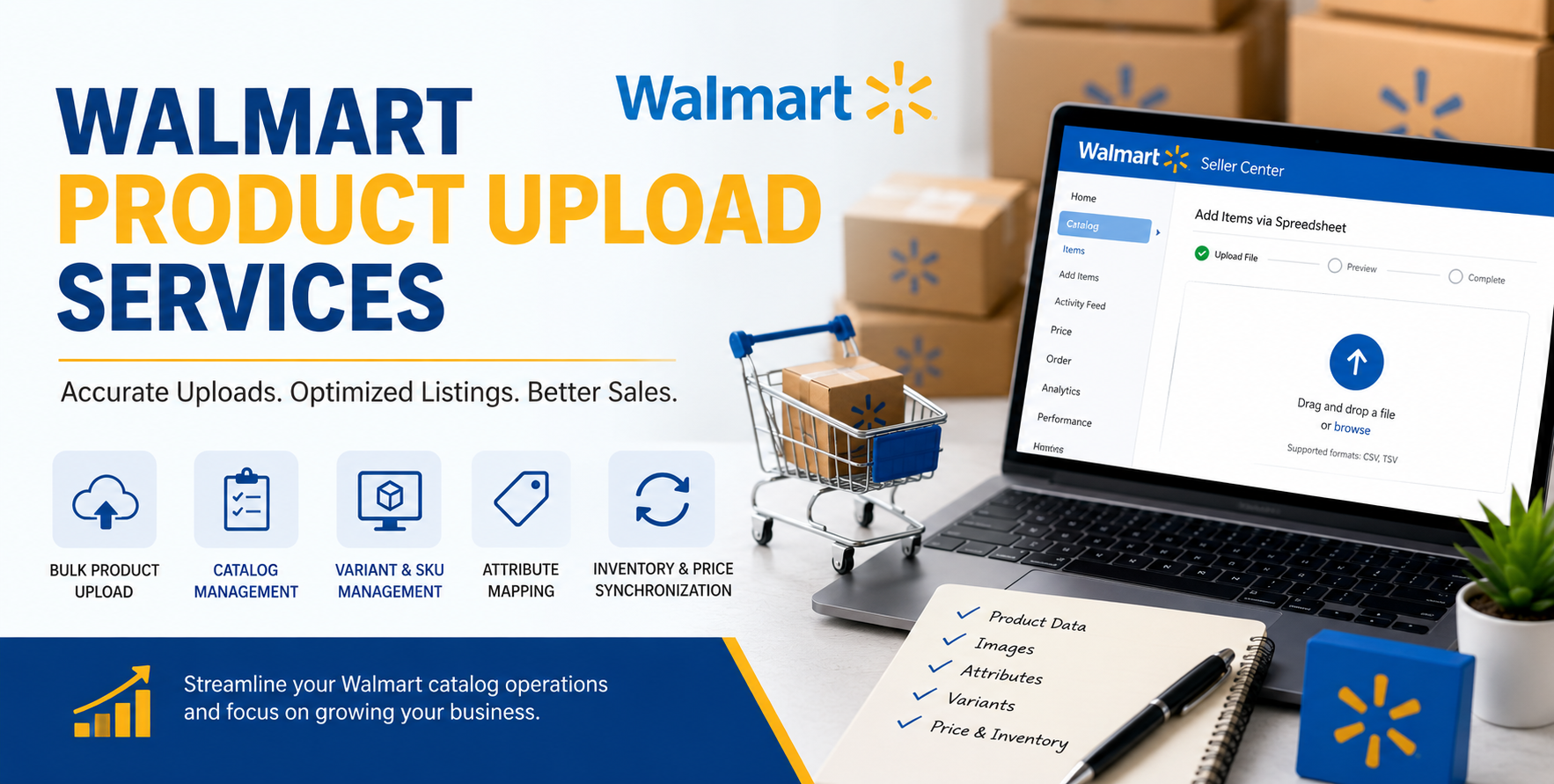
Walmart Product Upload Services
Uploading ten products to Walmart Marketplace is straightforward.
Uploading 12,000 SKUs with multiple size variants, changing inventory feeds, inconsistent manufacturer data, and marketplace compliance requirements is where operations start breaking down.
A home furnishing retailer once approached our team after their Walmart catalog suddenly lost visibility on hundreds of listings. The issue wasn’t pricing. It wasn’t demand either. Their internal team had uploaded duplicate identifiers across multiple product variations, and Walmart’s backend started suppressing listings automatically.
Three weeks of sales were affected because of a catalog structure problem.
This is exactly why Walmart product upload services have become essential for growing ecommerce sellers.
As catalogs expand across marketplaces, the backend workload becomes harder than most businesses expect.
Why Walmart Catalog Management Gets Complicated Fast
Walmart Marketplace has strict catalog standards compared to many other ecommerce platforms.
Product uploads involve much more than entering titles and prices. Sellers must manage:
- Product identifiers
- GTIN validation
- Variant relationships
- Inventory synchronization
- Image compliance
- Attribute mapping
- Category-specific specifications
- Feed formatting
- Duplicate prevention
Even small formatting inconsistencies can trigger:
- Unpublished listings
- Hidden products
- Search suppression
- Inventory mismatches
- Feed rejection errors
Many sellers realize this only after scaling operations.
A catalog with 300 SKUs can often be handled internally. A catalog with 30,000 products across seasonal inventory cycles is a completely different operational environment.
The Real Challenges Behind Walmart Product Uploads
Most Walmart sellers don’t struggle because the platform is difficult.
They struggle because catalog operations become repetitive, fragmented, and highly detail-sensitive.
Here are some of the most common operational problems ecommerce teams encounter.
1. Inconsistent Product Data
Manufacturers rarely provide clean catalog files.
One spreadsheet may contain:
- Missing UPCs
- Inconsistent dimensions
- Duplicate product names
- Incorrect variant relationships
- Mixed formatting
Before products are uploaded, data often requires extensive normalization.
Without structured cleanup, catalog inconsistencies spread across the entire marketplace account.
2. Variant Mapping Errors
Variant setup mistakes are one of the biggest causes of Walmart listing issues.
For example:
- Wrong parent-child relationships
- Missing color attributes
- Broken size groups
- Duplicate variation families
When this happens, shoppers may see:
- Incorrect product selections
- Missing variants
- Unavailable combinations
These errors also affect discoverability inside Walmart search results.
3. Bulk Upload Feed Problems
Many sellers rely on Walmart bulk upload templates.
The challenge is that bulk uploads are unforgiving.
A single formatting issue can reject:
- Hundreds of SKUs
- Inventory updates
- Pricing feeds
- Image uploads
Teams handling large catalogs usually need validation workflows before feed submission.
4. Marketplace Compliance Changes
Marketplace rules evolve regularly.
Category requirements that worked six months ago may suddenly require:
- Additional attributes
- Revised image standards
- New taxonomy structures
Catalog maintenance becomes an ongoing operational process, not a one-time task.
What Walmart Product Upload Services Actually Include
Many businesses assume product upload services only involve data entry.
In reality, experienced Walmart catalog teams typically handle multiple backend workflows.
Catalog Preparation
Before uploads begin, product information is reviewed for:
- Duplicate identifiers
- Missing attributes
- Formatting inconsistencies
- Category mismatches
- Image naming issues
This stage prevents downstream listing failures.
Product Listing Creation
This includes:
- Title formatting
- Feature bullet creation
- Specification mapping
- Backend attribute completion
- SEO-friendly product descriptions
Walmart’s algorithm relies heavily on structured product data accuracy.
Bulk SKU Uploads
For large inventories, uploads are usually managed through:
- CSV templates
- Flat files
- Feed management systems
- API-based workflows
Teams handling enterprise catalogs often segment uploads by:
- Category
- Vendor
- Seasonal collections
- Inventory status
This reduces large-scale feed failures.
Inventory and Price Updates
Catalog maintenance continues long after products go live.
Ongoing support may include:
- Stock synchronization
- Price revisions
- Discontinued product handling
- Replacement SKU management
- Feed troubleshooting
Without active maintenance, catalog quality gradually deteriorates.
Bulk Uploads vs Manual Listing: Where Most Teams Fail
Manual uploads work for small catalogs.
But operational cracks appear quickly during scale.
Here’s a common scenario:
A seller expands from Amazon into Walmart Marketplace with 8,000 SKUs. Their internal ecommerce assistant starts uploading products manually while inventory updates are managed separately.
Within weeks:
- Duplicate listings appear
- Inventory mismatches increase
- Pricing becomes inconsistent
- Variant families break
- Feed errors multiply
The issue isn’t effort.
It’s process structure.
Large catalog management requires:
- Standardized workflows
- Validation systems
- Naming conventions
- Marketplace-specific formatting
- Quality control reviews
Without process discipline, backend catalog issues become unavoidable.
Common Walmart Listing Errors That Hurt Sales
Some Walmart catalog mistakes are easy to overlook but directly affect visibility and conversion rates.
Weak Product Titles
Generic titles reduce search relevance.
Poor title:
“Women Shoes”
Optimized title:
“Women’s Running Shoes Lightweight Breathable Mesh Sneakers”
Structured titles improve:
- Keyword matching
- Shopper clarity
- Click-through rates
Missing Attributes
Incomplete backend attributes affect:
- Search discoverability
- Category placement
- Filtering visibility
Products with incomplete specifications often disappear from filtered search results.
Low-Quality Images
Walmart has strict image standards.
Common issues include:
- Watermarks
- Inconsistent backgrounds
- Low resolution
- Cropped product angles
Poor image compliance can suppress listings automatically.
Duplicate Listings
Duplicate products confuse both Walmart’s system and shoppers.
This often happens when:
- Multiple teams manage uploads
- Spreadsheets are merged incorrectly
- SKU structures lack standardization
Duplicate cleanup can become extremely time-consuming later.
How Experienced Catalog Teams Handle Large SKU Operations
Teams that manage large Walmart catalogs usually follow layered workflows instead of simple upload tasks.
A typical operational process may look like this:
Step 1: Product Data Audit
Before any upload:
- Data quality is checked
- Missing fields are identified
- Duplicate SKUs are flagged
- Taxonomy alignment is reviewed
Step 2: Attribute Standardization
Attributes are normalized for:
- Size
- Color
- Dimensions
- Material
- Compatibility
- Technical specifications
Consistency improves both search performance and catalog scalability.
Step 3: Marketplace Formatting
Every marketplace structures product data differently.
Walmart-specific formatting includes:
- Attribute hierarchy mapping
- Category-specific fields
- Backend taxonomy compliance
This is where generic ecommerce uploads often fail.
Step 4: Validation and Testing
Instead of uploading thousands of SKUs immediately, experienced teams often:
- Test small batches
- Monitor rejection reports
- Identify formatting conflicts
- Adjust templates before scaling
This prevents mass upload failures.
Step 5: Ongoing Catalog Maintenance
Catalog operations don’t stop after publishing.
Long-term management involves:
- Inventory feed monitoring
- Suppression tracking
- Listing updates
- Seasonal catalog refreshes
- Discontinued SKU handling
At India Data Entry Services, we’ve worked with ecommerce businesses managing catalogs across multiple marketplaces where backend maintenance became more demanding than customer-facing operations.
Marketplace-Specific Optimization Matters More Than Most Sellers Realize
Many ecommerce businesses copy Amazon listings directly into Walmart.
That usually creates problems.
Walmart shoppers behave differently, and Walmart’s marketplace structure prioritizes different listing signals.
Optimization often includes:
- Shorter feature-focused descriptions
- Cleaner specifications
- Category-specific attributes
- Structured backend fields
- Precise variant organization
Marketplace-specific formatting improves:
- Indexing
- Discoverability
- Listing approval rates
- Operational stability
A product feed that performs well on Shopify or Amazon may still fail Walmart validation checks.
When Should Businesses Outsource Walmart Product Uploads?
Not every seller needs external catalog support.
But outsourcing becomes practical when internal teams spend more time fixing listings than growing sales operations.
Businesses often outsource Walmart product upload services when they experience:
- Rapid SKU expansion
- Multi-marketplace complexity
- Recurring feed errors
- Delayed catalog launches
- Inconsistent product data
- Inventory synchronization issues
- Seasonal upload surges
One apparel company shifted catalog operations externally after their merchandising team spent nearly two months correcting variant errors before a holiday launch.
The upload process itself wasn’t the problem.
The operational workload surrounding the uploads was.
What to Look for in a Walmart Product Upload Service Provider
Choosing the right catalog support partner matters because Walmart backend errors compound quickly over time.
Look for teams with experience handling:
Large SKU Volumes
Managing 500 products is different from managing 50,000.
Large catalogs require scalable operational workflows.
Marketplace Knowledge
Walmart-specific expertise matters more than generic ecommerce experience.
Teams should understand:
- Feed structures
- Attribute mapping
- Suppression handling
- Variant architecture
Data Cleanup Capabilities
Most catalog projects involve incomplete or inconsistent product data.
Providers should handle:
- Normalization
- Deduplication
- Formatting correction
- Taxonomy alignment
Ongoing Maintenance Support
Catalog management is continuous.
Reliable support includes:
- Feed monitoring
- Update handling
- Inventory synchronization
- Listing corrections
At India Data Entry Services, many catalog management projects begin with product uploads but eventually expand into long-term marketplace maintenance because sellers realize how operationally intensive large catalogs become over time.
Final Thoughts
Walmart Marketplace growth creates operational pressure long before many sellers expect it.
The challenge usually isn’t uploading products.
It’s maintaining catalog accuracy while managing thousands of SKUs, inventory changes, variant relationships, and marketplace compliance requirements simultaneously.
Well-structured Walmart product upload services help businesses avoid:
- Listing suppression
- Duplicate products
- Inventory mismatches
- Broken variants
- Delayed launches
More importantly, they give ecommerce teams room to focus on pricing, advertising, merchandising, and growth instead of spending entire weeks correcting spreadsheet errors.
When catalogs scale, backend operations quietly become one of the biggest factors influencing marketplace performance.
FAQ Schema Questions
1. What are Walmart product upload services?
Walmart product upload services help sellers manage product listing creation, bulk SKU uploads, catalog formatting, attribute mapping, inventory updates, and marketplace compliance for Walmart Marketplace.
2. Why do Walmart product uploads fail?
Uploads commonly fail because of missing attributes, invalid UPCs, incorrect variant mapping, duplicate SKUs, formatting errors, or incomplete category specifications.
3. Can bulk products be uploaded to Walmart Marketplace?
Yes. Walmart supports bulk product uploads through spreadsheets, flat files, feeds, and API integrations for large catalog management.
4. What is included in Walmart catalog management services?
Services may include product data cleanup, listing optimization, bulk uploads, inventory synchronization, feed monitoring, error correction, and ongoing catalog maintenance.
5. How do Walmart listing errors affect sales?
Listing errors can reduce product visibility, suppress listings, create inventory mismatches, and negatively impact shopper trust and conversion rates.
6. Should ecommerce businesses outsource Walmart product uploads?
Outsourcing becomes beneficial when businesses manage large SKU volumes, multiple marketplaces, recurring feed errors, or limited internal catalog management resources.
Internal Link Opportunities
- Ecommerce Product Data Entry Services
- Product Catalog Management Services
- Amazon Product Upload Services
- Shopify Product Listing Services
- Ecommerce Back Office Support
- Inventory Management Services
- Marketplace Listing Optimization Services
- Data Cleansing Services
- SKU Management Solutions
- Product Image Editing Services