

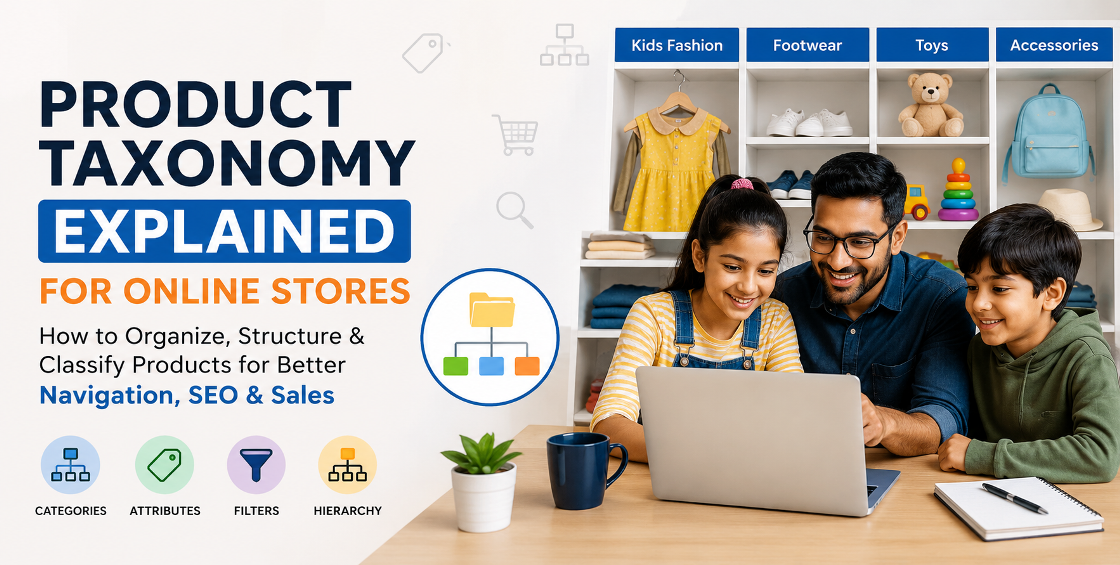


Product Taxonomy Explained for Online Stores
A catalog with 200 products can survive a few organizational mistakes. A catalog with 20,000 products usually can't.
One apparel retailer approached us after launching three new marketplaces in six months. Their products were selling, but customers struggled to find similar items, duplicate listings appeared across categories, and internal teams argued over where products belonged. The issue wasn't pricing or inventory—it was a poorly planned product taxonomy.
Taxonomy is one of those backend foundations customers rarely notice when it's done well. Yet it quietly influences browsing, filtering, search accuracy, marketplace approvals, reporting, and even search engine visibility.
If your catalog is growing—or you're planning to expand into platforms like Shopify, Amazon, WooCommerce, Magento, Walmart Marketplace, or eBay—understanding product taxonomy becomes far more than an organizational exercise.
What Is Product Taxonomy?
Product taxonomy is the structured way an online store organizes products into categories, subcategories, and product attributes.
Think of it as the blueprint that determines where every product belongs and how customers discover it.
Instead of uploading products randomly, every item follows a logical hierarchy.
For example:
- Electronics
- Mobile Phones
- Android Phones
- iPhones
- Tablets
- Smart Watches
- Mobile Phones
Or for fashion:
- Men
- Shirts
- Casual Shirts
- Formal Shirts
- Jeans
- Jackets
- Shirts
Each level narrows the customer's search until they quickly reach the exact product they're looking for.
Without a consistent taxonomy, even the best products become difficult to discover.
Why Product Taxonomy Matters More Than Many Retailers Realize
Many store owners assume taxonomy is simply about creating categories.
In practice, it influences nearly every operational workflow.
A well-organized taxonomy helps with:
- Easier product discovery
- Better onsite search results
- Accurate product filtering
- Faster product uploads
- Cleaner marketplace listings
- Improved reporting
- Better customer experience
- More consistent catalog maintenance
Imagine adding 50 new kitchen appliances every week.
If one employee categorizes an air fryer under Kitchen Appliances while another places it under Home Essentials, customers receive inconsistent browsing experiences, and analytics become harder to interpret.
These small inconsistencies multiply quickly as catalogs grow.
The Building Blocks of a Strong Product Taxonomy
A scalable taxonomy isn't built from categories alone. It combines several layers that work together.
Categories
Categories represent the broadest grouping.
Examples include:
- Electronics
- Furniture
- Clothing
- Beauty
- Sports
They help customers begin their shopping journey.
Subcategories
Subcategories refine product groups into more specific sections.
Example:
- Furniture
- Living Room
- Bedroom
- Dining Room
- Office Furniture
This additional structure prevents categories from becoming overcrowded.
Product Attributes
Attributes describe the characteristics of a product.
Common examples include:
- Brand
- Size
- Color
- Material
- Weight
- Capacity
- Style
- Compatibility
These fields power product filters that customers rely on every day.
Instead of browsing hundreds of products, shoppers can narrow results within seconds.
Variants
Variants represent different versions of the same product.
Examples include:
- Color
- Storage Capacity
- Size
- Finish
Keeping variants grouped under a single parent product creates a cleaner shopping experience while reducing duplicate listings.
Common Product Taxonomy Mistakes
Many catalog issues don't appear immediately. They develop gradually as multiple teams upload products using different naming conventions.
Here are some of the most common problems.
Creating Too Many Categories
Some retailers create categories for every product type imaginable.
Instead of:
Electronics → Headphones
They end up with:
- Gaming Headphones
- Bluetooth Gaming Headphones
- Premium Bluetooth Gaming Headphones
- RGB Gaming Headphones
Overly deep navigation makes browsing frustrating.
Mixing Categories and Attributes
A frequent mistake is treating colors as categories.
Incorrect:
- Women's Clothing
- Red Dresses
- Blue Dresses
- Black Dresses
Better:
- Women's Clothing
- Dresses
Filter by:
- Red
- Blue
- Black
Attributes should remain filters whenever possible.
Duplicate Categories
Small naming differences often create duplicate structures.
Examples include:
- Laptop Bags
- Laptop Backpacks
- Notebook Bags
- Computer Bags
Without governance, similar products become scattered across multiple sections.
Inconsistent Naming
One employee writes:
"T-Shirts"
Another writes:
"Tee Shirts"
A third uploads:
"Tees"
Customers—and search filters—now treat these as separate product groups.
Creating taxonomy guidelines helps maintain consistency.
How Product Taxonomy Supports SEO
Search engines understand websites through structure.
A logical category hierarchy creates meaningful URLs and internal linking patterns.
For example:
/electronics/mobile-phones/android/
is far more descriptive than:
/category123/item45/
Organized taxonomy also supports:
- Category landing pages
- Breadcrumb navigation
- Better crawlability
- Improved internal linking
- Rich product organization
While taxonomy alone won't guarantee higher rankings, it provides a solid technical foundation for ecommerce SEO.
Marketplace Listings Depend on Accurate Taxonomy
Every marketplace follows its own category rules.
- Amazon requires products to fit predefined browse nodes.
- Google Merchant Center expects standardized product classifications.
- Shopify collections depend on accurate tagging and categorization.
When taxonomy isn't aligned internally, product uploads often require manual corrections before publication.
Uploading 50 products manually is manageable.
Maintaining 75,000 SKUs across Shopify, Amazon, Walmart Marketplace, and eBay—with each platform expecting different category structures—is where most operations teams start encountering avoidable errors.
Building a Product Taxonomy That Can Grow With Your Business
Rather than designing for today's catalog, design for the catalog you'll have two years from now.
A practical workflow often looks like this:
Step 1: Audit Existing Products
Review:
- Duplicate categories
- Missing attributes
- Similar product groups
- Inconsistent naming
Patterns usually emerge quickly.
Step 2: Group Similar Products
Focus on customer shopping behavior.
Ask:
"What would customers naturally expect to see together?"
Not:
"Which department manages these products?"
Internal departments rarely match customer expectations.
Step 3: Standardize Naming Rules
Document conventions for:
- Category names
- Attribute values
- Brand formatting
- Measurements
- Capitalization
This prevents future inconsistencies.
Step 4: Define Required Attributes
Not every product requires identical information.
A laptop may need:
- Processor
- RAM
- Storage
A sofa requires:
- Upholstery
- Material
- Seating Capacity
Each category should have mandatory attributes tailored to its products.
Step 5: Test Navigation
Before finalizing the taxonomy, ask team members unfamiliar with the project to locate products.
If several people struggle to find the same item, the structure likely needs refinement.
Maintaining Taxonomy Over Time
Creating taxonomy is only the beginning.
Retailers regularly introduce:
- New brands
- Seasonal collections
- Marketplace expansions
- Product bundles
- Private-label products
Without ongoing governance, even a well-designed catalog gradually becomes inconsistent.
Many businesses establish periodic catalog reviews where duplicate categories, outdated attributes, and redundant product groups are identified before they affect customer experience.
At India Data Entry Services, we've seen that consistent catalog maintenance often saves more time than large-scale cleanup projects after years of unmanaged growth.
When Does It Make Sense to Review Your Product Taxonomy?
Consider a full review if you notice:
- Customers struggle to find products
- Search returns irrelevant results
- Duplicate listings keep appearing
- Teams disagree on product placement
- Marketplace uploads require repeated manual fixes
- Category pages become overcrowded
- Reporting categories no longer reflect the business accurately
These are often symptoms of structural issues rather than isolated data entry mistakes.
Final Thoughts
Product taxonomy isn't just an internal filing system. It's the framework behind product discovery, navigation, filtering, reporting, and marketplace consistency.
A thoughtful hierarchy reduces confusion for customers and simplifies daily work for catalog managers. As your product range expands, a scalable taxonomy becomes one of the most valuable long-term investments you can make in your ecommerce operations.
For businesses managing large or rapidly changing catalogs, periodic taxonomy reviews can prevent small inconsistencies from becoming costly cleanup projects. At India Data Entry Services, we've worked with retailers managing thousands of SKUs across multiple ecommerce platforms, where a well-planned taxonomy often becomes the difference between an orderly catalog and one that continually demands manual fixes.
Frequently Asked Questions
1. What is product taxonomy in ecommerce?
Product taxonomy is the structured organization of products into categories, subcategories, attributes, and variants to improve navigation, search, and catalog management.
2. How is product taxonomy different from product categorization?
Product categorization assigns products to categories, while product taxonomy includes the complete hierarchical structure, attributes, relationships, and classification rules across the catalog.
3. Why is product taxonomy important for SEO?
A logical taxonomy improves site structure, internal linking, category pages, URL organization, and helps search engines understand relationships between products.
4. What are product attributes?
Product attributes describe characteristics such as size, color, material, brand, dimensions, compatibility, and other specifications that enable product filtering.
5. How often should an ecommerce taxonomy be reviewed?
Growing ecommerce businesses should review their taxonomy periodically—especially after adding new product lines, entering new marketplaces, or noticing recurring catalog inconsistencies.