



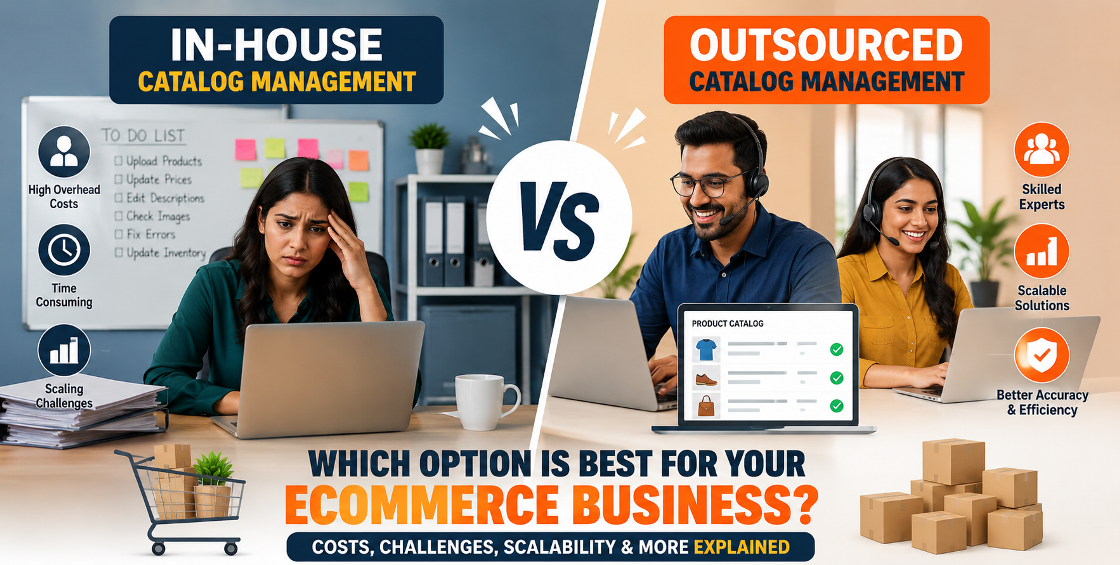
In-House vs Outsourced Catalog Management: Which Option Makes More Sense for Growing Ecommerce Businesses?
Uploading a handful of products is rarely a challenge.
The real problems begin when catalogs start growing faster than the teams managing them.
A retailer with 200 products may comfortably handle updates internally. The same retailer can find themselves overwhelmed six months later after expanding to Amazon, Shopify, Walmart Marketplace, eBay, and regional marketplaces. Suddenly there are thousands of SKUs, product variations, pricing updates, inventory synchronization requirements, image revisions, and category mapping tasks.
This is often the point where business owners start asking a critical question:
Should catalog management stay in-house, or should it be outsourced?
The answer depends on far more than cost. It involves scalability, accuracy, speed, staffing, marketplace expertise, and long-term operational goals.
Let's examine both approaches from a practical ecommerce operations perspective.
Why Catalog Management Becomes a Bottleneck Faster Than Most Retailers Expect
Catalog management isn't just data entry.
A typical product listing may require:
- Product title optimization
- Attribute mapping
- Product descriptions
- SKU creation
- Category assignment
- Image management
- Inventory updates
- Price revisions
- Variant setup
- Marketplace compliance checks
Now multiply that process across thousands of products.
Many ecommerce teams discover that catalog work quietly consumes valuable time that could otherwise be spent on marketing, merchandising, supplier negotiations, or customer acquisition.
One company we observed had three employees spending nearly half their workweek fixing listing errors across multiple marketplaces after a platform migration. The actual migration took a few days. Correcting catalog inconsistencies took months.
What In-House Catalog Management Looks Like
An in-house catalog management model means all catalog-related activities are handled by internal employees.
This may include:
- Ecommerce managers
- Product information specialists
- Marketplace coordinators
- Data entry personnel
- Merchandising teams
The organization controls every aspect of the process directly.
Advantages of In-House Catalog Management
Greater Internal Control
Managers can supervise workflows closely and implement changes immediately.
When a supplier updates product specifications or pricing, internal teams can respond without coordinating with external vendors.
Better Product Familiarity
Internal staff often develop deep knowledge of products, categories, and brand guidelines.
This can be valuable for businesses selling highly technical, specialized, or regulated products.
Easier Department Collaboration
Catalog teams can communicate directly with:
- Marketing departments
- Purchasing teams
- Inventory managers
- Customer service representatives
This can reduce communication delays.
Challenges of In-House Catalog Management
Hiring Costs
Building a capable catalog team requires:
- Recruitment
- Training
- Salaries
- Benefits
- Software licenses
- Management oversight
These costs accumulate quickly.
Scalability Problems
Seasonal spikes create immediate staffing challenges.
A retailer preparing for holiday sales may need to upload thousands of new SKUs within a short period.
Internal teams often struggle to absorb sudden workload increases.
Employee Turnover
Catalog processes are highly detail-oriented.
When experienced employees leave, knowledge gaps emerge and productivity often drops while replacements are trained.
What Outsourced Catalog Management Really Involves
Outsourced catalog management means working with a specialized service provider that handles some or all catalog-related tasks.
Services often include:
- Product uploads
- Product data entry
- SKU management
- Marketplace listing creation
- Catalog audits
- Product attribute enrichment
- Bulk catalog updates
- Inventory synchronization
Rather than building a large internal team, businesses access trained catalog specialists as needed.
Advantages of Outsourced Catalog Management
Faster Scaling
An experienced outsourcing provider can often increase resources quickly during:
- Product launches
- Marketplace expansions
- Seasonal demand spikes
- Catalog migration projects
Businesses avoid the delays associated with hiring and training.
Access to Specialized Expertise
Marketplace requirements change frequently.
Amazon, Shopify, Walmart Marketplace, Magento, BigCommerce, and other platforms each have unique listing structures.
Dedicated catalog teams work with these systems daily.
Lower Operational Overhead
Businesses reduce expenses associated with:
- Recruitment
- Employee benefits
- Workspace costs
- Ongoing training
Consistent Productivity
Work continues regardless of employee vacations, sick leave, resignations, or staffing shortages.
Comparing In-House vs Outsourced Catalog Management Across Key Areas
1. Cost
In-House
- Fixed payroll expenses
- Hiring costs
- Training investments
- Employee benefits
Outsourced
- Predictable service pricing
- Flexible resource allocation
- Reduced infrastructure costs
For many growing ecommerce businesses, outsourcing produces lower overall operational costs.
2. Scalability
In-House
Scaling requires:
- New hiring
- Additional training
- Expanded management oversight
Outsourced
Resources can often be increased immediately depending on project requirements.
This becomes especially valuable during rapid growth periods.
3. Accuracy
In-House
Accuracy depends heavily on employee experience and workload management.
Overloaded teams tend to produce more listing errors.
Outsourced
Specialized catalog providers often use established quality-control procedures designed specifically for catalog operations.
4. Platform Knowledge
In-House
Knowledge varies depending on employee experience.
Training may be required when expanding into new marketplaces.
Outsourced
Many providers already have expertise across multiple ecommerce platforms and marketplaces.
5. Management Requirements
In-House
Managers oversee:
- Staffing
- Training
- Performance monitoring
- Process documentation
Outsourced
Management responsibilities shift toward project coordination and performance review.
The Hidden Costs Most Companies Overlook
When comparing options, businesses often focus exclusively on payroll versus outsourcing fees.
The larger costs frequently come from operational mistakes.
Duplicate Listings
Duplicate products can create inventory confusion, pricing inconsistencies, and poor customer experiences.
Attribute Errors
Incorrect dimensions, specifications, or compatibility information can increase product returns.
Marketplace Compliance Issues
Missing mandatory attributes can suppress listings or reduce product visibility.
Slow Product Launches
Delayed uploads often translate into lost sales opportunities.
The cost of these issues can exceed the savings achieved through a cheaper staffing model.
When an In-House Team Makes Sense
- Product complexity is extremely high
- Catalog volumes are relatively stable
- Strong internal ecommerce resources already exist
- Products require extensive technical expertise
When Outsourcing Becomes the Better Option
- SKU counts are growing rapidly
- Marketplace expansion is underway
- Internal teams are overloaded
- Large catalog cleanup projects are required
At India Data Entry Services, we've helped retailers manage product catalogs during platform migrations, marketplace expansion projects, and large-scale catalog optimization initiatives where accuracy directly impacts product visibility and revenue.
A Real-World Multi-Channel Catalog Scenario
Consider a retailer selling home furnishings.
Initially they operate exclusively through Shopify with 800 products.
Catalog management remains manageable.
The company then expands to:
- Amazon
- Walmart Marketplace
- eBay
- Regional ecommerce platforms
The catalog grows to 12,000 SKUs with multiple product variants.
Now the team must manage:
- Marketplace-specific attributes
- Inventory synchronization
- Product image updates
- Seasonal pricing changes
- New supplier catalogs
An internal team that previously handled everything comfortably may suddenly spend most of its time performing maintenance rather than driving growth initiatives.
This is where outsourced catalog management frequently shifts from being a cost-saving measure to becoming an operational necessity.
Questions to Ask Before Making a Decision
- How many SKUs are currently managed?
- How quickly is the catalog growing?
- How many marketplaces require support?
- What is the current error rate?
- How much management time is being spent on catalog issues?
- Are seasonal spikes causing bottlenecks?
- Does the business have documented catalog workflows?
- Is expansion planned within the next 12 months?
Final Thoughts
The debate between in-house and outsourced catalog management is not simply about reducing costs.
It is about maintaining catalog accuracy, supporting growth, improving operational consistency, and ensuring products reach customers without delays or listing issues.
For smaller, stable catalogs, an internal team may provide sufficient control and flexibility.
For businesses managing thousands of SKUs across multiple sales channels, outsourcing can provide the scalability, expertise, and operational support needed to keep catalog operations running smoothly.
The most effective approach is the one that allows your organization to spend less time fixing product data problems and more time focusing on growth.
Frequently Asked Questions
Is outsourced catalog management suitable for small ecommerce businesses?
Yes. Small businesses often use outsourced support to avoid hiring dedicated catalog staff while maintaining accurate product listings.
What tasks are typically included in catalog management services?
Services usually include product uploads, data entry, attribute management, inventory updates, category mapping, image handling, and marketplace listing maintenance.
How do outsourced catalog teams maintain accuracy?
Most providers use quality-control procedures, validation checks, standardized workflows, and multi-level review processes.
Can outsourced teams manage multiple ecommerce platforms?
Yes. Many providers support Shopify, Amazon, Walmart Marketplace, Magento, BigCommerce, eBay, and other ecommerce platforms.
When should a company switch from in-house to outsourced catalog management?
Businesses often consider outsourcing when SKU volumes increase significantly, marketplace expansion creates additional workload, or internal teams become overwhelmed.