



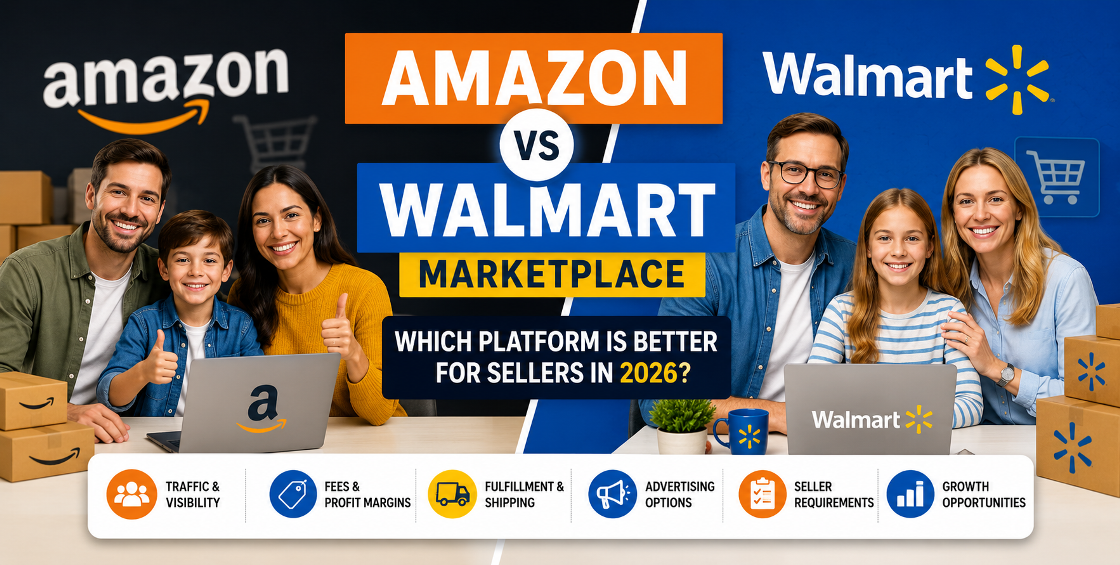
Amazon vs Walmart Marketplace: Which Platform Is Better for Sellers in 2026?
A product can perform exceptionally well on one marketplace and struggle on another—even when the price, images, and descriptions are identical.
We've seen this happen repeatedly.
One home goods retailer expanded from Amazon to Walmart expecting similar sales patterns. Instead, they discovered that products buried beneath thousands of competitors on Amazon were receiving significantly more visibility on Walmart simply because the marketplace wasn't as saturated.
Choosing between Amazon and Walmart isn't just about traffic. It affects advertising costs, fulfillment strategy, catalog management, operational workload, and ultimately profit margins.
For sellers planning marketplace expansion, understanding the differences between Amazon and Walmart has become increasingly important.
Amazon and Walmart: Two Very Different Marketplace Ecosystems
Although both platforms allow third-party sellers to reach millions of online shoppers, their operating environments are fundamentally different.
Amazon functions as a massive global marketplace with intense competition across nearly every category.
Walmart Marketplace remains more selective, with fewer sellers and lower competition in many product segments.
This distinction influences everything from product discoverability to customer acquisition costs.
Quick Marketplace Comparison
| Factor | Amazon Marketplace | Walmart Marketplace |
|---|---|---|
| Seller Base | Very large | More selective |
| Competition Level | Extremely high | Moderate |
| Customer Traffic | Massive global reach | Strong U.S. audience |
| Approval Process | Relatively straightforward | More selective |
| Fulfillment Program | Amazon FBA | Walmart Fulfillment Services (WFS) |
| Advertising Competition | High | Lower in many categories |
| Brand Visibility | Challenging for new sellers | Often easier |
| International Reach | Extensive | Primarily U.S.-focused |
Seller Approval and Onboarding
The first major difference appears before the first product is even listed.
Amazon Seller Registration
Amazon allows most businesses to create seller accounts relatively quickly.
The onboarding process typically involves:
- Business verification
- Tax information submission
- Identity verification
- Bank account validation
For many sellers, approval happens without significant delays.
Walmart Marketplace Approval
Walmart follows a more selective approach.
Applications are reviewed based on factors such as:
- Business history
- Ecommerce experience
- Product quality
- Operational capabilities
- Marketplace performance records
As a result, some sellers are approved immediately while others may not qualify.
This selective model contributes to Walmart's lower seller saturation.
Competition and Product Visibility
Competition often determines how quickly a new seller gains traction.
Selling on Amazon
Amazon offers enormous customer traffic.
However, that traffic attracts millions of sellers.
Consider a common product category such as kitchen accessories.
A search may return thousands of competing listings featuring:
- Similar products
- Comparable pricing
- Aggressive advertising
- Established review histories
New sellers frequently struggle to gain visibility without substantial advertising investments.
Selling on Walmart Marketplace
Walmart's marketplace generally contains fewer competing sellers.
This creates opportunities for:
- Faster product discovery
- Lower advertising competition
- Improved organic ranking potential
- Greater visibility for newer brands
Many sellers discover they can achieve first-page placement more easily than on Amazon.
That doesn't guarantee sales, but it can reduce customer acquisition costs.
Fees and Cost Structure
Marketplace fees directly affect profitability.
Amazon Marketplace Fees
Amazon sellers typically encounter:
- Referral fees
- FBA fees (if used)
- Storage fees
- Advertising expenses
- Subscription fees
For large catalogs, these expenses can accumulate quickly.
Long-term storage fees alone can impact margins when inventory forecasting isn't managed carefully.
Walmart Marketplace Fees
Walmart generally charges:
- Referral fees
- Optional fulfillment costs through WFS
Notably, Walmart does not charge a monthly seller subscription fee for marketplace participation.
For some businesses, this results in a lower barrier to entry.
However, overall profitability depends on product category, fulfillment strategy, and advertising spend.
Fulfillment Services: Amazon FBA vs Walmart Fulfillment Services
Fulfillment capabilities significantly influence customer satisfaction and marketplace performance.
Amazon FBA
Benefits include:
- Prime eligibility
- Fast delivery
- Inventory management support
- Customer service handling
- Returns processing
For many sellers, FBA simplifies operations considerably.
The trade-off is increased fee complexity.
Walmart Fulfillment Services (WFS)
Advantages include:
- Faster shipping options
- Marketplace fulfillment support
- Inventory storage
- Returns handling
- Improved product visibility
While WFS continues to grow, Amazon's fulfillment network remains larger and more mature.
Businesses heavily dependent on logistics efficiency may find Amazon's infrastructure difficult to match.
Catalog Management Challenges on Both Platforms
Many marketplace comparisons focus on traffic and fees.
Operational complexity often receives less attention.
Yet this is where many sellers encounter problems.
Uploading 100 products manually is manageable.
Maintaining 100,000 SKUs across multiple marketplaces is an entirely different challenge.
Common catalog issues include:
- Duplicate listings
- Incorrect product attributes
- Inventory mismatches
- Category errors
- Missing images
- Pricing inconsistencies
When products exist simultaneously on Amazon, Walmart, Shopify, and additional channels, data accuracy becomes critical.
At India Data Entry Services, we've worked with retailers managing large-scale product catalogs where a small data inconsistency triggered inventory discrepancies across multiple marketplaces.
As catalog size grows, marketplace management becomes increasingly dependent on structured backend operations rather than front-end selling tactics.
Advertising Differences
Amazon Advertising
Amazon's advertising ecosystem is highly developed.
Sellers can use:
- Sponsored Products
- Sponsored Brands
- Sponsored Display
- Video advertising
The downside is increased competition.
Popular categories often experience significant bid inflation.
Walmart Connect
Walmart's advertising platform continues expanding.
Benefits often include:
- Lower competition
- Lower advertising costs
- Emerging opportunities
- Improved visibility for new sellers
Many brands use Walmart advertising as a complementary acquisition channel rather than a direct replacement for Amazon ads.
Which Marketplace Works Best for Different Business Types?
Amazon May Be Better For:
- International sellers
- High-volume brands
- Businesses seeking global reach
- Companies relying on Prime customers
- Mature ecommerce operations
Walmart May Be Better For:
- U.S.-focused brands
- Sellers seeking lower competition
- Businesses expanding marketplace presence
- Emerging brands building visibility
- Companies testing new product categories
Neither platform is universally superior.
The right choice depends on product category, margins, operational resources, and long-term growth objectives.
The Most Successful Sellers Often Use Both
A common misconception is that sellers must choose one marketplace.
Increasingly, successful ecommerce businesses operate across both.
The strategy typically looks like this:
- Establish performance on Amazon.
- Expand to Walmart Marketplace.
- Synchronize inventory.
- Standardize product data.
- Manage listings centrally.
- Monitor channel-specific performance.
This approach reduces dependence on a single marketplace while increasing customer reach.
One retailer we worked with initially sold exclusively on Amazon. After expanding to Walmart and cleaning up product data inconsistencies across channels, they gained additional sales opportunities without dramatically increasing operational overhead.
The challenge wasn't marketplace expansion itself.
It was maintaining accurate product information across every selling channel.
Final Thoughts
Amazon remains the dominant marketplace in terms of scale, traffic, and fulfillment infrastructure.
Walmart Marketplace offers a less crowded environment where sellers can often gain visibility more easily.
For businesses evaluating marketplace expansion, the decision should extend beyond traffic numbers. Competition levels, fulfillment costs, catalog complexity, advertising expenses, and operational capacity all influence marketplace success.
Many growing ecommerce brands ultimately discover that the strongest position comes from maintaining a presence on both platforms while investing in accurate catalog management and marketplace operations behind the scenes.
Frequently Asked Questions
Is Walmart Marketplace better than Amazon for new sellers?
Walmart often offers lower competition, making it easier for some new sellers to gain product visibility. Amazon, however, provides access to a much larger customer base.
Does Walmart charge a monthly seller fee?
Walmart Marketplace generally does not require a monthly seller subscription fee, unlike Amazon's Professional Seller plan.
Which marketplace has more customers?
Amazon has a significantly larger global customer base and broader international reach.
Is Walmart Marketplace harder to join?
Yes. Walmart typically follows a more selective approval process compared to Amazon.
Can sellers use both Amazon and Walmart?
Yes. Many ecommerce businesses operate on both marketplaces to diversify revenue and expand market reach.
Which fulfillment service is better?
Amazon FBA currently offers a larger and more mature logistics network, while Walmart Fulfillment Services continues expanding and improving.
```