
Why Product Specifications Matter in eCommerce
12 Aug 2026

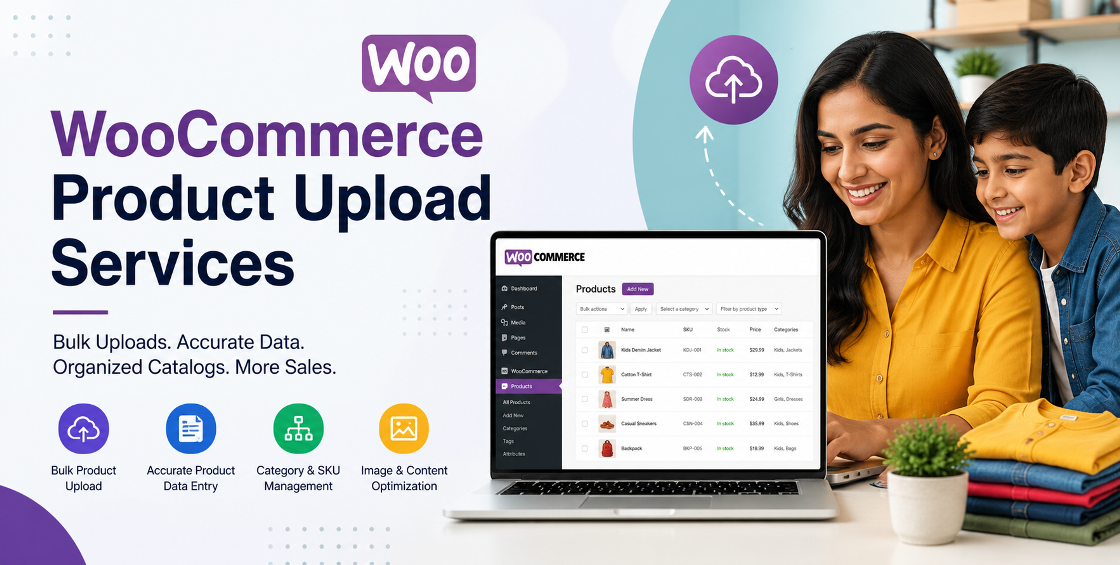
A mid-sized home décor seller once approached us with a familiar situation: their WooCommerce store was “technically live,” but barely usable.
Products were uploaded, yes. But inconsistently.
Some listings had images missing. Variations were duplicated. Attributes like size and material were stored differently across categories. Search filters didn’t work properly, and customers kept landing on empty or broken product pages.
The internal team had spent weeks uploading products manually, switching between spreadsheets, admin panels, and supplier files.
What looked like a simple task—uploading products to WooCommerce—had quietly turned into a catalog breakdown.
This is where WooCommerce product upload services stop being a “nice to have” and start becoming operational infrastructure.
WooCommerce is flexible, which is both its strength and its weakness.
At 50 products, everything feels manageable. At 5,000, patterns start to matter. At 50,000 SKUs, inconsistency becomes expensive.
Here’s where most teams start running into trouble:
One supplier sends “color,” another sends “shade,” and a third uses custom labels. WooCommerce treats them as separate filters, breaking layered navigation.
Simple products turn into variable products with size, material, pack type, and region-based differences.
Duplicate images, missing alt text, wrong resolutions, and mismatched SKUs slow down catalog publishing.
Even a trained team struggles when every product requires 10–15 fields filled correctly.
A single formatting issue in WooCommerce CSV product upload files can break an entire batch import.
At this point, the issue is no longer “uploading products.” It becomes catalog engineering.
A structured product upload process is closer to data engineering than simple entry work.
Here’s how experienced ecommerce operations teams handle it.
Before anything touches WooCommerce, raw supplier data is cleaned:
Without this step, every downstream upload becomes inconsistent.
WooCommerce doesn’t just store products—it organizes relationships between them.
A proper structure defines:
This is where most internal teams underestimate complexity.
Depending on store size:
A well-prepared file ensures:
This is the stage most teams skip.
A structured QA process checks:
One missed error here can affect hundreds of customer interactions.
After publishing, catalog behavior is monitored:
This ensures products are not just uploaded—but actually usable.
Most ecommerce teams assume WooCommerce product upload services are about speed.
In reality, the real challenge is consistency across thousands of SKUs.
A few examples we’ve seen in real operations:
These aren’t small errors. They directly affect:
At scale, catalog structure becomes a revenue factor, not just backend hygiene.
There’s usually a predictable moment when in-house teams start struggling:
One ecommerce client told us their team spent nearly three weeks fixing duplicate listings instead of adding new products.
That’s usually the turning point where outsourcing becomes practical.
Teams don’t outsource because they can’t do the work—they outsource because maintaining catalog accuracy stops being sustainable internally.
When WooCommerce catalogs are handled with a structured approach, the difference is immediate:
At this stage, even marketing performance improves because product discovery is no longer broken by backend inconsistencies.
At India Data Entry Services India Data Entry Services, we’ve seen catalogs with thousands of SKUs move from unstable setups to structured systems simply by standardizing upload workflows and cleaning backend data logic.
Even experienced ecommerce operators fall into these traps:
Leads to fragmented filters and poor UX.
Duplicate SKUs create inventory confusion.
It’s a structured product database, not Excel.
Errors multiply instead of getting caught early.
This is where most catalog chaos begins.
12 Aug 2026


