
Why Product Specifications Matter in eCommerce
12 Aug 2026

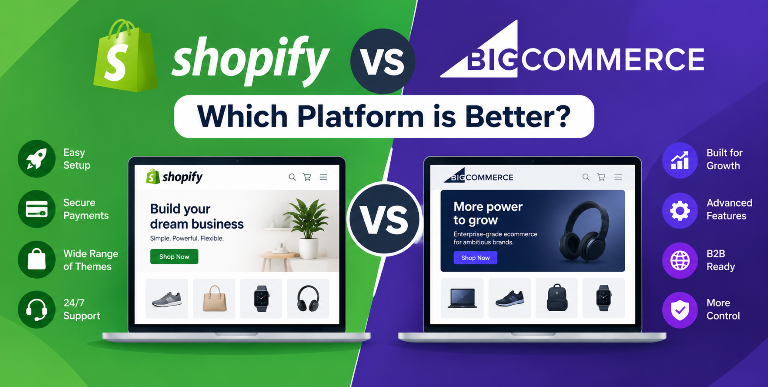
For first-time ecommerce businesses, Shopify generally provides the smoother onboarding experience.
Its dashboard feels intuitive, product creation is straightforward, and most users become comfortable within a few hours.
BigCommerce includes more configuration options from the beginning, which offers flexibility but also introduces a steeper learning curve.
Winner: Shopify
Catalog size changes the conversation.
A small boutique with 150 products has very different operational needs than an electronics distributor managing 60,000 SKUs.
BigCommerce performs particularly well with:
Shopify handles large catalogs successfully too, although some advanced catalog requirements may require additional applications.
At India Data Entry Services, we’ve worked with retailers maintaining extensive product databases across multiple ecommerce platforms. In many cases, success depends less on the platform itself and more on establishing structured catalog management processes from the outset.
Winner: BigCommerce for highly complex catalogs
Shopify offers one of the largest collections of professionally designed themes.
Its customization ecosystem is enormous, giving merchants access to designers, developers, and specialized agencies worldwide.
BigCommerce also provides quality themes but offers fewer options overall.
Winner: Shopify
One reason Shopify remains popular is its marketplace.
Whether businesses require:
There is usually an app available.
BigCommerce supports integrations as well but focuses more on built-in functionality.
Winner: Shopify
Search visibility often depends on much more than keywords.
Technical SEO factors include:
BigCommerce offers greater flexibility in several technical SEO settings out of the box.
Shopify performs well but occasionally requires workarounds or applications for advanced customization.
Winner: BigCommerce
At first glance, monthly subscription fees appear similar.
However, total operating costs depend on:
Some Shopify stores eventually depend on numerous paid applications.
BigCommerce includes more built-in functionality, reducing the need for additional subscriptions.
Businesses should evaluate the total cost of ownership rather than monthly pricing alone.
Modern ecommerce rarely depends on a single storefront.
Merchants often sell through:
Both platforms support multi-channel selling effectively.
Shopify offers exceptional marketplace integrations through its app ecosystem.
BigCommerce emphasizes centralized catalog management with native capabilities.
Result: Both platforms perform well depending on operational priorities.
Platform features are only part of the equation.
Operational discipline becomes increasingly important as catalogs expand.
One retailer approached us after discovering thousands of duplicate listings following several seasonal imports. Product titles differed slightly across marketplaces, images had inconsistent naming conventions, and pricing updates failed because SKU structures varied between systems.
The platform wasn’t the root cause.
The underlying product data lacked consistency.
A scalable catalog usually depends on:
Whether using Shopify or BigCommerce, organized product data reduces costly errors during migrations and daily catalog maintenance.
Businesses frequently underestimate migration complexity.
Moving products between ecommerce platforms often involves more than exporting a spreadsheet.
Typical issues include:
Different platforms organize products differently.
Without planning, navigation becomes confusing after migration.
Color, size, material, and packaging options may not transfer cleanly.
Variant mapping should always be validated before publishing.
Metadata, redirects, alt text, and structured information can disappear during migration if not properly mapped.
Product images frequently break because file paths change.
Large catalogs require image validation after import.
Minor inconsistencies become major issues when thousands of SKUs are involved.
Examples include:
Standardization before migration saves significant cleanup later.
Instead of asking which platform has more features, ask operational questions.
For example:
Answers to these questions often make the platform choice much clearer.
Businesses with ambitious expansion plans should also evaluate how product information will be maintained over time. At India Data Entry Services, we’ve seen that well-structured catalog processes frequently have a greater impact on long-term efficiency than the initial platform selection itself.
There isn’t a universal winner in the Shopify vs BigCommerce debate.
Shopify stands out for ease of use, flexibility, and its extensive ecosystem, making it an excellent fit for many small to mid-sized businesses and fast-growing brands.
BigCommerce excels when businesses require advanced native functionality, robust catalog structures, and enterprise-oriented capabilities without relying heavily on third-party applications.
The strongest choice depends on your product complexity, operational workflows, growth plans, and internal resources. Evaluating those factors before committing to a platform can save considerable time, effort, and migration costs later.
12 Aug 2026