Why Product Specifications Matter in eCommerce
12 Aug 2026

One fashion retailer thought migrating to a larger ecommerce platform would solve every operational issue. Instead, their team spent weeks fixing broken product variants, inconsistent pricing, duplicate SKUs, and inventory mismatches across multiple sales channels. The platform wasn’t the real problem—the business had simply outgrown its existing processes.
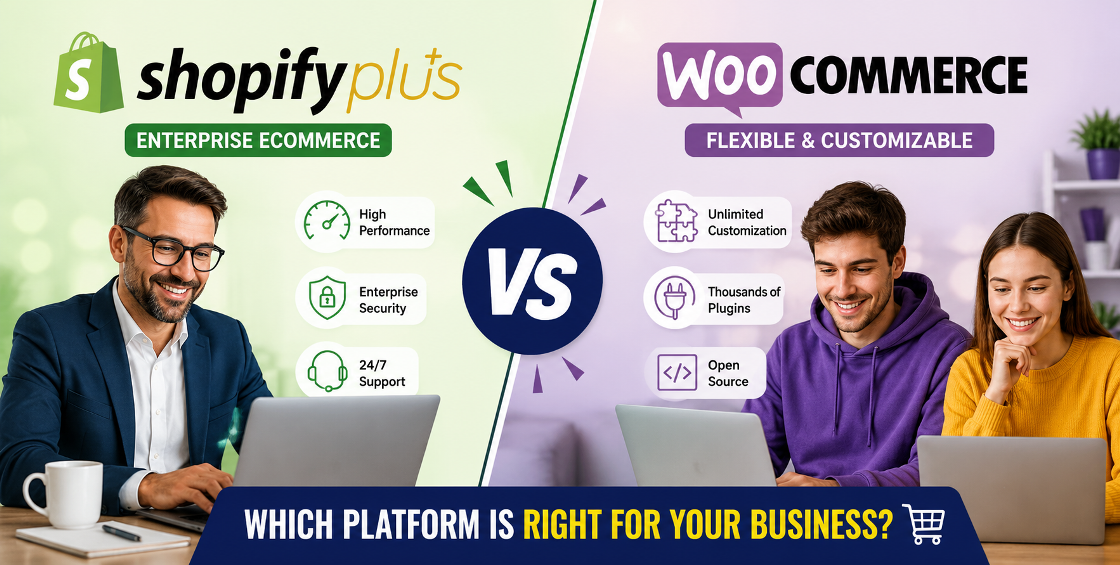
Choosing between Shopify Plus and WooCommerce isn’t only about software features. It also affects how your team manages products, updates catalogs, integrates systems, supports customers, and expands into new markets.
If you’re comparing Shopify Plus vs WooCommerce, this guide breaks down both platforms from an operational perspective rather than simply listing features.
Shopify Plus is Shopify’s enterprise-grade ecommerce platform designed for businesses handling high sales volumes, multiple storefronts, international expansion, and complex automation.
Instead of worrying about hosting, software updates, or server maintenance, merchants focus on growing their stores while Shopify manages the infrastructure behind the scenes.
Key strengths include:
Many brands choose Shopify Plus because operational complexity often increases much faster than revenue. Managing thousands of products across several storefronts becomes significantly easier when the platform handles technical maintenance.
WooCommerce is an open-source ecommerce plugin built for WordPress. Unlike Shopify Plus, it gives merchants complete ownership over their website and nearly unlimited customization options.
For businesses with experienced developers or agencies, WooCommerce can support almost any business model.
Popular reasons companies choose WooCommerce include:
However, flexibility also means greater responsibility.
Store owners are responsible for:
As stores become larger, these technical responsibilities require dedicated resources.
| Feature | Shopify Plus | WooCommerce |
|---|---|---|
| Hosting | Included | Self-hosted |
| Setup | Faster | More technical |
| Customization | High | Virtually unlimited |
| Security | Managed | Self-managed |
| Maintenance | Shopify handles updates | Store owner manages updates |
| Performance | Optimized by Shopify | Depends on hosting |
| Enterprise Support | Included | Depends on hosting/provider |
| Development Flexibility | Moderate | Extremely high |
| Initial Technical Skills | Low | Medium to High |
| Scalability | Excellent | Excellent with proper infrastructure |
Comparing subscription prices alone rarely gives the full picture.
Shopify Plus includes many enterprise services within its subscription.
WooCommerce itself is free, but businesses often invest in:
For smaller stores, WooCommerce may appear more affordable.
For enterprise retailers, the total cost of ownership depends on ongoing technical management rather than software licensing alone.
Some businesses require highly customized buying experiences.
Examples include:
WooCommerce generally provides greater development flexibility because developers have direct access to the entire platform.
Shopify Plus also supports significant customization but within a managed ecosystem designed to maintain stability and performance.
The right choice depends on whether your priority is unrestricted development or operational simplicity.
Uploading 100 products manually isn’t difficult.
Maintaining 75,000 SKUs across multiple countries, marketplaces, seasonal campaigns, and inventory systems is where operational challenges begin.
Growing retailers often encounter issues such as:
Platform selection should take these daily operational tasks into account—not just the customer-facing website.
At India Data Entry Services, we’ve supported businesses managing extensive ecommerce catalogs across multiple platforms, where maintaining consistent product information often becomes just as important as selecting the ecommerce platform itself.
Businesses working against tight deadlines often prioritize rapid deployment.
Shopify Plus typically enables faster launches because much of the technical infrastructure is already configured.
WooCommerce projects generally require additional planning for:
The trade-off is greater long-term flexibility.
WooCommerce benefits from WordPress’s mature content management ecosystem.
Businesses publishing extensive blogs, buying guides, and educational content often appreciate the advanced SEO flexibility available through WordPress.
Shopify Plus also supports strong SEO fundamentals, including:
For most businesses, long-term SEO success depends more on content quality, technical implementation, and site architecture than on the platform alone.
Modern ecommerce rarely operates in isolation.
Most growing retailers connect their stores with:
Shopify Plus offers a polished ecosystem with many pre-built integrations.
WooCommerce provides tremendous flexibility but may require more custom integration work depending on the business environment.
Neither option is universally superior. Each excels under different operational requirements.
One common mistake is choosing a platform based only on current business size.
Instead, evaluate where your business may be in three to five years.
Consider questions such as:
Answering these questions often provides more clarity than comparing feature lists.
Whether moving from WooCommerce to Shopify Plus or the reverse, migration involves far more than transferring product pages.
A successful migration should account for:
Many businesses underestimate the time required to clean existing catalog data before migration begins. In practice, organized product information often determines how smoothly a new platform performs after launch.
Shopify Plus and WooCommerce are both capable ecommerce platforms with proven track records.
Shopify Plus emphasizes simplicity, managed infrastructure, and enterprise scalability.
WooCommerce prioritizes ownership, flexibility, and deep customization.
The better option depends less on feature checklists and more on your team’s technical capabilities, operational workflows, catalog complexity, and long-term business strategy.
For organizations managing large-scale product data, marketplace listings, or frequent catalog updates, investing in structured backend processes can be just as valuable as choosing the platform itself. At India Data Entry Services, we’ve seen firsthand that well-maintained product information reduces errors and supports smoother growth regardless of the ecommerce system in use.
12 Aug 2026