
Why Product Specifications Matter in eCommerce
12 Aug 2026

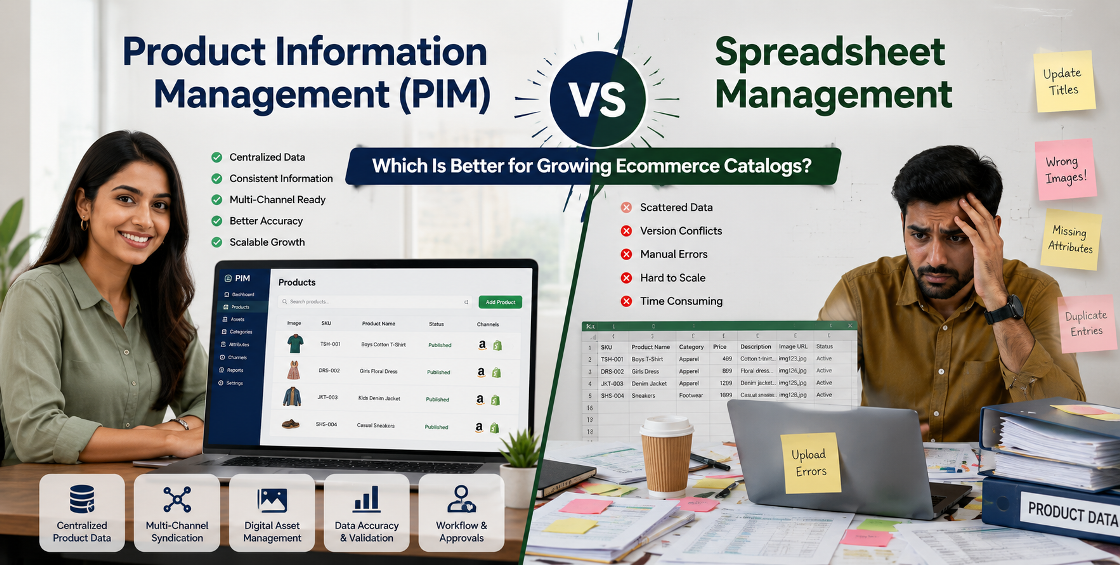
Uploading twenty products into an Excel sheet rarely causes problems.
Uploading twenty thousand products across Shopify, Amazon, eBay, WooCommerce, and a B2B portal is an entirely different story.
That’s usually the point where catalog teams begin noticing small issues that gradually turn into larger operational headaches. A missing product description on one marketplace, outdated specifications on another, duplicate SKUs, inconsistent images, and conflicting pricing often have the same root cause—product information is being managed across multiple spreadsheets by different people.
Many ecommerce businesses begin with spreadsheets because they’re familiar, inexpensive, and flexible. However, as product catalogues expand and sales channels multiply, spreadsheets often become difficult to maintain.
This raises an important question:
Should you continue managing product data in spreadsheets, or is it time to invest in a Product Information Management (PIM) system?
Let’s compare both approaches from an operational perspective rather than simply listing software features.
Every new product introduces additional information that needs to remain consistent.
That includes:
Now multiply that by thousands of SKUs.
Then add multiple marketplaces, multiple departments, seasonal updates, supplier changes, and different regional requirements.
Suddenly, one spreadsheet becomes ten. Ten become fifty. Before long, nobody is completely certain which version contains the latest information.
The challenge isn’t entering product data—it’s keeping every version accurate.
Spreadsheet management refers to maintaining product information using tools such as Microsoft Excel or Google Sheets.
Most ecommerce businesses begin this way because spreadsheets are:
A typical spreadsheet might include:
| SKU | Product Name | Price | Description | Category | Stock |
|---|---|---|---|---|---|
| SKU001 | Sample Product | £49.99 | Sample Description | Electronics | 150 |
As businesses grow, additional sheets often appear for:
Eventually, multiple teams begin editing different copies simultaneously.
That’s when version control becomes a daily challenge.
A Product Information Management (PIM) system is a central repository designed specifically for organising, enriching, validating, and distributing product information across multiple sales channels.
Instead of storing product details in disconnected spreadsheets, a PIM creates one trusted source of product data.
Information entered once can be published consistently to:
Rather than replacing ecommerce platforms, a PIM works alongside them by managing the product information before it’s published.
| Feature | Spreadsheet Management | Product Information Management (PIM) |
|---|---|---|
| Centralised product data | Limited | Yes |
| Multiple user collaboration | Basic | Advanced |
| Version control | Manual | Automatic |
| Data validation | Minimal | Built-in rules |
| Multi-channel publishing | Manual | Automated |
| Product relationships | Difficult | Easy |
| Large SKU management | Challenging | Designed for it |
| Workflow approvals | No | Yes |
| Attribute management | Manual | Structured |
| Scalability | Limited | High |
The biggest difference isn’t simply technology.
It’s control.
Spreadsheets depend heavily on people remembering processes.
A PIM embeds those processes into the system.
Despite their limitations, spreadsheets remain a sensible choice in certain situations.
If you’re selling fewer than 100 products on a single website, spreadsheets may be perfectly adequate.
When one or two people manage product updates, collaboration issues are minimal.
Products with few attributes and infrequent updates rarely justify investing in a dedicated PIM.
Many startups sensibly delay adopting specialist software until operational complexity increases.
The key is recognising when spreadsheets stop saving time and start creating hidden costs.
One retailer approached our team after spending nearly a month reconciling conflicting catalogue versions across two marketplaces and an internal ERP.
The issue wasn’t poor data entry—it was that every department maintained its own spreadsheet.
Situations like these are common indicators that a business has reached the limits of spreadsheet-based management.
Watch for these warning signs:
These operational bottlenecks often become more expensive than investing in better product data management.
The value of a PIM isn’t limited to storing information. It also improves the entire product data workflow.
Every department accesses the same information rather than maintaining separate copies. This reduces confusion and improves consistency.
Instead of every product containing slightly different specifications, attribute templates help maintain uniformity.
These remain consistent across the entire catalogue.
Launching products on a new marketplace becomes much simpler when product information already exists in one structured location. Instead of rebuilding listings, teams map existing fields to marketplace requirements.
Many PIM systems flag missing information before products are published, helping prevent incomplete listings from reaching customers.
Marketing can update descriptions. Merchandising can adjust categories. Operations can manage SKUs. Approval workflows ensure changes are reviewed before publication.
Implementing a PIM doesn’t automatically solve data problems. Several mistakes can make migration more difficult than expected.
A PIM will faithfully store whatever information it’s given. If duplicate products, inconsistent naming conventions, or missing attributes already exist, they’ll simply be transferred into the new system. Cleaning data first usually saves considerable effort later.
Without standard naming rules, attribute definitions, and SKU structures, teams continue creating inconsistent product records. Technology alone can’t replace governance.
Successful implementations often begin with a limited product range before expanding across the full catalogue. A phased rollout allows teams to refine workflows without disrupting daily operations.
Rather than asking which system is universally better, ask which one matches your current stage of growth.
A spreadsheet is often enough when:
A PIM becomes worthwhile when:
The transition isn’t about replacing spreadsheets because they’re outdated. It’s about reducing operational friction as product information becomes increasingly complex.
At India Data Entry Services, we’ve worked with retailers and ecommerce businesses managing everything from modest online stores to extensive catalogues containing tens of thousands of SKUs. One recurring lesson is that the right data management process often matters just as much as the technology itself.
Whether your team continues using spreadsheets or adopts a PIM, maintaining clean, structured, and consistent product data remains the foundation of successful ecommerce operations.
Spreadsheets have helped countless ecommerce businesses get started, and for many, they continue to serve an important role.
However, growth changes the equation.
As product ranges expand, sales channels multiply, and more teams become involved, maintaining accuracy through spreadsheets alone becomes increasingly difficult. A Product Information Management system offers structure, governance, and scalability that manual processes struggle to match.
The best choice depends on your catalogue size, operational complexity, and future plans. If managing product information is starting to consume more time than selling products, it may be the right moment to rethink how your data is organised.
12 Aug 2026