
Why Product Specifications Matter in eCommerce
12 Aug 2026

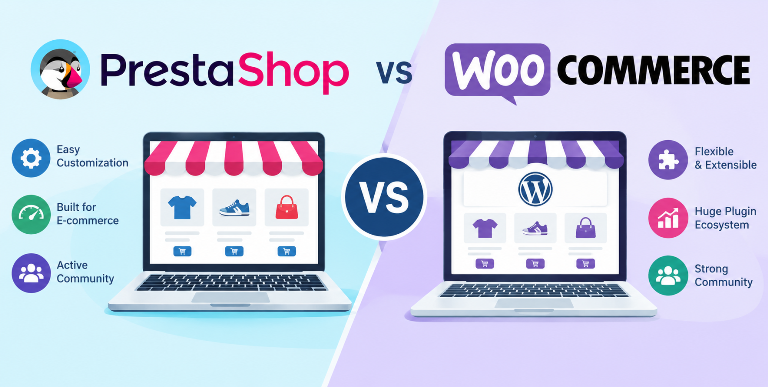
A store with 200 products rarely exposes the weaknesses of an ecommerce platform. Everything appears manageable until the catalog grows into thousands of SKUs, suppliers begin sending frequent inventory updates, and products need to be listed across multiple marketplaces. That’s often when platform limitations start affecting everyday operations.
We’ve seen retailers spend weeks correcting category structures after switching platforms too late. Others discovered that managing product variations, supplier feeds, and multilingual catalogs became increasingly difficult as their business expanded.
Choosing between PrestaShop vs WooCommerce isn’t simply about selecting popular software. It’s about deciding which platform will continue supporting your business as product catalogs, customer expectations, and operational complexity increase.
This comparison looks beyond marketing claims and focuses on the practical realities of running an ecommerce business.
Although both platforms allow businesses to build online stores, they take different approaches.
WooCommerce is an ecommerce plugin built for WordPress. It’s popular because many businesses are already familiar with the WordPress ecosystem. Installation is relatively simple, and thousands of themes and plugins are available.
PrestaShop, on the other hand, is a dedicated ecommerce platform designed specifically for online retail. Its architecture focuses entirely on ecommerce functionality rather than extending a content management system.
That difference becomes more noticeable as stores become larger and workflows more demanding.
| Feature | WooCommerce | PrestaShop |
|---|---|---|
| Ease of Setup | Beginner-friendly | Moderate learning curve |
| Platform Type | WordPress plugin | Dedicated ecommerce platform |
| Customization | Extensive plugin ecosystem | Strong module ecosystem |
| Large Catalog Handling | Good with optimization | Excellent for large inventories |
| SEO | Excellent with WordPress plugins | Strong built-in SEO features |
| Performance | Depends on hosting and plugins | Optimized for ecommerce workloads |
| Multi-language Support | Plugin-based | Built-in capabilities |
| Multi-store Support | Requires extensions | Native support |
| Scalability | High with proper optimization | Designed for scaling retail stores |
| Community Support | Very large | Active global community |
This is where operational teams often notice the biggest differences.
Uploading 100 products manually isn’t difficult. Maintaining 100,000 SKUs across seasonal collections, supplier updates, discontinued products, and multiple warehouses is an entirely different challenge.
PrestaShop’s backend is built around ecommerce operations. Features such as product combinations, supplier management, warehouse functionality, and advanced catalog organization are integrated into the platform.
WooCommerce can certainly manage large catalogs, but success often depends on selecting the right hosting environment, database optimization, caching solutions, and compatible plugins.
Businesses expecting rapid inventory growth should evaluate not only current catalog size but also future operational requirements.
Many platform comparisons focus on features while overlooking the repetitive tasks that consume the most time.
Consider a typical merchandising workflow:
These activities occur continuously rather than occasionally.
At India Data Entry Services, we’ve supported retailers managing thousands of SKUs across ecommerce platforms. In many projects, the biggest challenge wasn’t product uploads themselves—it was maintaining consistency across categories, attributes, product variations, and marketplace listings over time.
A platform that simplifies backend organization often reduces manual corrections later.
Many business owners compare only software costs.
The larger expense usually comes from ongoing maintenance.
While WooCommerce itself is free, businesses frequently invest in:
Each addition can improve functionality, but together they increase maintenance complexity.
PrestaShop also offers a free core platform, although businesses often purchase:
Because many ecommerce-specific features are already built around retail operations, businesses may rely on fewer third-party extensions for core functionality.
The better value depends less on licensing costs and more on how many customizations your business requires.
Organic traffic remains one of the most cost-effective customer acquisition channels.
WooCommerce benefits from the mature WordPress ecosystem, making content marketing especially powerful. Businesses can combine ecommerce with blogs, buying guides, comparison articles, and educational content using well-established SEO plugins.
PrestaShop includes solid SEO functionality for product pages, categories, clean URLs, and metadata. While content marketing may require additional planning, the platform performs well for product-focused stores.
If publishing regular educational content forms part of your growth strategy, WooCommerce often provides greater flexibility.
If product discovery and catalog organization are the primary focus, PrestaShop performs exceptionally well.
Both platforms offer extensive customization, although the development experience differs.
WooCommerce developers benefit from WordPress familiarity and a massive plugin marketplace.
PrestaShop developers work within an ecommerce-first framework designed specifically for online retail.
Businesses with unique workflows—such as supplier automation, ERP integration, or marketplace synchronization—should evaluate developer availability alongside platform capabilities.
The easiest platform isn’t always the easiest to customize responsibly.
Security isn’t a one-time task.
Updates, plugin compatibility, server monitoring, backups, and vulnerability management all require attention.
WooCommerce maintenance often involves monitoring multiple plugins from different developers.
PrestaShop also requires updates, but businesses generally manage fewer third-party dependencies for essential ecommerce functions.
Regardless of platform, regular maintenance is essential for protecting customer data and ensuring consistent performance.
PrestaShop is often well suited for businesses that:
Businesses focused primarily on retail operations frequently appreciate its ecommerce-first architecture.
WooCommerce is an excellent fit for businesses that:
For many growing brands, WooCommerce offers an accessible balance between flexibility and usability.
Several issues appear repeatedly during platform selection.
Migration costs often exceed setup costs.
Catalog updates, inventory management, and product imports deserve as much attention as storefront design.
Each plugin introduces another maintenance responsibility.
Product attributes, customer records, SEO URLs, and category structures require careful planning during migration.
One retailer approached us after duplicate product listings appeared across hundreds of categories following a rushed migration. Cleaning the catalog ultimately required more time than the migration itself.
Careful preparation almost always saves time later.
The choice between PrestaShop vs WooCommerce depends less on popularity and more on how your business operates.
If your strategy revolves around content marketing, WordPress familiarity, and gradual growth, WooCommerce provides remarkable flexibility.
If your priorities include large product catalogs, structured inventory management, multilingual commerce, and dedicated ecommerce functionality, PrestaShop offers a strong operational foundation.
Neither platform is universally better. The right decision comes from matching platform strengths with your long-term business processes rather than short-term preferences.
As ecommerce operations become more complex, accurate product data, organized catalogs, and consistent backend management become just as important as the platform itself. At India Data Entry Services, we’ve seen well-managed catalog operations contribute significantly to smoother store performance, regardless of the underlying ecommerce system.
12 Aug 2026