
Why Product Specifications Matter in eCommerce
12 Aug 2026

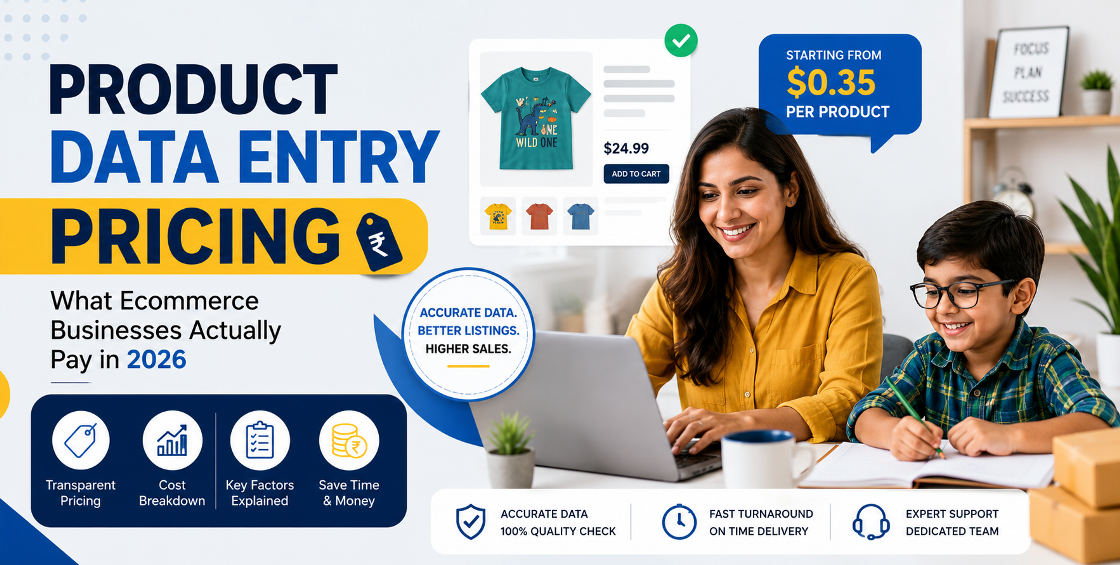
A fashion retailer recently approached us after migrating from Magento to Shopify. Their internal team assumed product uploads would take “a few days.” Three weeks later, they were still fixing variant mismatches, duplicate SKUs, broken image links, and missing size attributes across nearly 18,000 products.
The actual migration wasn’t the problem.
The catalog management process was.
Uploading 20 products manually is manageable. Maintaining 20,000 SKUs across Shopify, Amazon, Walmart, eBay, and supplier feeds is where ecommerce operations become expensive — especially when pricing structures are unclear from the beginning.
That’s why product data entry pricing varies dramatically between businesses.
Some companies charge per SKU. Others bill hourly. Some bundle catalog optimization, image handling, taxonomy mapping, and marketplace formatting into one package. Without understanding what’s included, retailers often underestimate both workload and long-term maintenance costs.
This article breaks down how ecommerce product data entry pricing actually works, what influences costs, and where businesses typically overspend.
Two ecommerce stores may each have 10,000 products, yet one project could cost five times more than the other.
Here’s why.
A simple catalog might include:
A complex catalog often involves:
One electronics seller may require UPC verification and technical specifications for every product. A furniture retailer may need dimensional attributes, shipping classes, lifestyle images, and marketplace-specific formatting.
The workload changes completely.
That’s why experienced ecommerce operations teams rarely provide flat pricing without reviewing catalog complexity first.
Many retailers calculate only the visible upload cost.
What they miss are the operational bottlenecks caused by poor product data management.
Here’s what usually happens when catalogs scale too quickly:
Products go live with outdated pricing or incorrect stock quantities.
This becomes especially problematic for:
One home decor brand ended up with nearly 4,000 duplicate listings after importing supplier feeds from multiple distributors.
Their Amazon account health dropped because identical products were competing against each other internally.
Cleaning the catalog cost more than the original upload work.
Messy product data affects:
Poor taxonomy structures quietly reduce conversion rates over time.
Amazon, Walmart, Etsy, and eBay each have different listing requirements.
Missing fields, invalid image sizes, or incorrect variation structures can delay product approvals for days.
Different providers structure pricing differently depending on catalog size and complexity.
Here are the most common models used in ecommerce catalog management.
This is the most common pricing structure.
Typical pricing depends on:
Simple uploads generally cost less than highly configurable catalogs.
Best suited for:
Some agencies charge hourly for ongoing catalog maintenance.
This model works well when:
Hourly pricing is common for long-term ecommerce backend support.
Larger retailers often hire dedicated catalog teams instead of paying per project.
This usually includes:
At India Data Entry Services, we’ve seen this model work particularly well for businesses managing multiple storefronts and large supplier networks.
Some ecommerce operations combine:
This approach is common for growing DTC brands that frequently expand product catalogs.
Pricing is rarely based only on product count.
Several operational factors influence actual catalog management costs.
A catalog with:
is significantly easier than:
Variation mapping alone can multiply workload dramatically.
Uploading products to Shopify is different from preparing Amazon listings.
Amazon often requires:
Each marketplace adds additional formatting work.
Poor supplier data increases manual cleanup time.
Common problems include:
One cosmetics retailer spent weeks correcting supplier spreadsheets before uploads could even begin.
Many businesses underestimate image-related work.
Tasks may include:
For fashion and furniture stores, image preparation can become a major part of total project cost.
Some businesses only need uploads.
Others require:
This adds content and optimization layers beyond simple data entry.
The cheapest quote often becomes the most expensive project later.
Here’s where unexpected costs appear.
Incorrect taxonomy structures create long-term navigation problems.
Fixing categories after thousands of products go live is time-consuming and risky.
Low-cost providers sometimes:
The cleanup phase usually costs more than doing the work correctly initially.
Migrating between:
often creates formatting conflicts.
Attribute structures don’t always transfer cleanly between platforms.
Incorrect Amazon listings can trigger:
Poor catalog governance directly affects sales continuity.
Retailers eventually face the same question:
Should catalog management stay internal or move to a specialized external team?
The answer depends on scale.
However, internal teams often struggle during:
Many ecommerce brands outsource because catalog operations become repetitive, time-intensive, and difficult to scale internally.
At India Data Entry Services, we’ve worked with retailers who initially assigned catalog management to marketing or admin staff — until operational errors started affecting revenue and inventory accuracy.
Pricing varies by provider and complexity, but here’s how projects are commonly structured.
| Catalog Type | Typical Scope |
|---|---|
| Small Store | Basic uploads with limited variations |
| Mid-Sized Ecommerce Catalog | Marketplace formatting + category mapping |
| Enterprise Catalog | Multi-marketplace management + ongoing updates |
| Migration Projects | Data restructuring + platform compatibility |
| Marketplace Expansion | Amazon/eBay/Walmart optimization |
The more marketplaces involved, the more operational complexity increases.
Retailers often increase costs unintentionally.
Here are the most common operational mistakes.
Many brands delay process improvements until:
Early catalog governance prevents expensive cleanup projects later.
Catalog management affects:
It’s operational infrastructure, not just typing work.
Poor category architecture creates:
Fixing taxonomy after scaling becomes difficult.
The cheapest option rarely includes:
Operational reliability matters more than initial pricing alone.
Before selecting a provider, retailers should evaluate:
Ask whether the team has worked with:
Can they manage:
Look for:
Marketplace formatting mistakes create expensive delays.
Teams should understand:
Operational projects fail when updates become unclear.
Dedicated account handling and documented workflows reduce confusion significantly.
Product data entry pricing is rarely about entering product names into spreadsheets.
Most ecommerce businesses are actually paying for:
As catalogs grow, the complexity behind product management grows faster than most teams expect.
A well-managed catalog improves:
A poorly managed one quietly creates problems across the entire ecommerce business.
That difference is usually reflected in the pricing.
12 Aug 2026


