Choosing between selling on an online marketplace and building your own eCommerce website is an important decision for any product-based business. Marketplaces such as Amazon, eBay and Walmart give sellers access to established shopping audiences. An independent website, on the other hand, provides greater control over branding, customer relationships and the shopping experience.
Both channels can generate sales, but they work differently. A marketplace can help customers discover products they have never purchased before, while your own website gives you more opportunities to build brand loyalty and encourage repeat purchases.
The decision is not necessarily about choosing one channel permanently. For many growing businesses, the more practical approach is to understand what each channel does best and use them together where the economics make sense.
1. Understanding the Difference Between a Marketplace and Your Own Website
An online marketplace is a third-party platform where multiple sellers list their products and compete for customer orders. Amazon, eBay, Walmart Marketplace and Etsy are common examples.
Your own eCommerce website is an online store operated under your business’s domain. You control the website design, product presentation, navigation, promotions and customer experience. Platforms such as Shopify and WooCommerce provide tools to build and manage these stores.
The main difference is the level of control and responsibility.
- Marketplace: The platform provides an established shopping environment, customer traffic and marketplace infrastructure.
- Own website: Your business manages its storefront and customer journey while taking responsibility for attracting visitors and building trust.
Neither model automatically guarantees higher sales or better profitability. The outcome depends on the products, target audience, operating costs and marketing capabilities.
2. Selling Through Online Marketplaces: Advantages and Disadvantages
Marketplaces are attractive because businesses do not need to build an entire shopping platform before reaching potential customers. They can register as sellers, prepare product listings and begin competing for orders once their accounts and products meet the platform’s requirements.
Advantages of marketplace selling
Access to an existing customer base
Customers already visit marketplaces to search for products. This gives sellers an opportunity to reach shoppers who may not know their brand or website.
For a business introducing a new product range, this existing demand can make marketplaces a useful starting point.
Established shopping infrastructure
Major marketplaces provide systems for product discovery, checkout, payment processing and order management. Some also offer fulfilment and shipping programmes, depending on the platform and seller’s location.
This can reduce the amount of infrastructure a business needs to establish independently.
Faster route to market
Businesses with an existing product catalogue can often start marketplace selling without investing in a completely new website. The main work involves seller registration, catalogue preparation, product categorisation and listing compliance.
Customer confidence
Many shoppers are familiar with established marketplaces. Their existing experience with checkout, delivery tracking and returns can make them more comfortable purchasing from unfamiliar sellers.
Disadvantages of marketplace selling
Marketplace fees affect profitability
Depending on the platform and product category, sellers may pay referral commissions, subscription fees, fulfilment charges, storage fees and advertising costs.
These expenses should be calculated before setting product prices. A product with an attractive selling price may generate very little contribution margin after all selling and fulfilment costs are deducted.
Strong competition
Customers can compare similar products from different sellers on the same platform. If several businesses offer nearly identical products, price, reviews, delivery options and listing quality can influence the buying decision.
Limited control over the customer experience
Marketplace sellers must follow the platform’s design, listing and communication policies. They cannot customise every part of the buying journey or use every branding feature available on an independent website.
Dependence on platform policies
Marketplace requirements, fees, seller performance standards and account policies can change. Businesses that depend on one platform for most of their revenue may find themselves exposed to changes outside their control.
3. Selling Through Your Own eCommerce Website: Advantages and Disadvantages
An independent eCommerce website gives a business greater control over its digital storefront. However, having a website does not automatically bring customers. The business must invest in visibility, marketing, customer service and website operations.
Advantages of owning an eCommerce website
Greater brand control
Your website can reflect your brand identity through its design, colours, product photography, content, navigation and shopping experience.
You can also explain product benefits in greater detail and organise product categories around the way your customers prefer to shop.
Direct customer relationships
When customers purchase through your website, you can manage customer relationships using the information collected with appropriate consent and in accordance with applicable privacy regulations.
This creates opportunities for permission-based email marketing, loyalty programmes, product recommendations and customer retention campaigns.
More flexibility in product presentation
Your own store allows you to create detailed landing pages, product comparison sections, buying guides, bundles and promotional campaigns.
This is particularly useful for businesses selling technical products, specialised equipment, furniture or products that require detailed explanations before purchase.
Greater control over merchandising
You can organise product collections, feature selected products, create seasonal promotions and introduce exclusive product bundles according to your commercial strategy.
Disadvantages of owning a website
You must generate your own traffic
Unlike established marketplaces, an independent website does not automatically have a large audience looking for products.
Businesses need to invest in search engine optimisation, paid advertising, content marketing, social media, email campaigns or other customer acquisition methods.
More operational responsibility
Your business is responsible for maintaining the website, processing orders, managing payment systems, coordinating deliveries and handling customer enquiries.
Depending on the business model, additional responsibilities may include fraud prevention, website security, tax configuration and returns management.
Building customer trust takes time
Customers unfamiliar with your brand may want to check your business information, product reviews, delivery policies, return conditions and payment security before placing an order.
Establishing that confidence requires consistent service and a reliable shopping experience.
4. Marketplace vs Own Website: Key Differences Compared
The following comparison highlights the main differences businesses should consider before selecting their primary sales channel.
| Business Factor |
Online Marketplace |
Own Website |
| Customer traffic |
Existing marketplace audience |
Business must attract visitors |
| Initial setup |
Seller registration and listing preparation |
Website setup and store configuration |
| Selling costs |
Platform fees, commissions and other charges |
Hosting, platform, payment and marketing costs |
| Brand control |
Limited by platform rules |
Greater customisation |
| Customer relationship |
Restricted by marketplace policies |
Direct relationship subject to consent and privacy laws |
| Competition |
Competing sellers appear on the same platform |
More control over the shopping environment |
| Product presentation |
Platform-specific listing formats |
Custom product pages and content |
| Marketing |
Marketplace advertising and promotions |
SEO, paid ads, email and other channels |
| Platform dependence |
Higher dependence on marketplace policies |
Greater storefront control, with dependence on hosting and technology providers |
| Repeat purchases |
Subject to platform customer access rules |
More opportunities for direct retention marketing |
The important point is that lower platform fees do not automatically mean higher profits. Your website may avoid marketplace commissions, but the cost of attracting each customer can be substantial.
5. Which Selling Channel Is Better for Different Types of Businesses?
The right channel depends on your products, business stage, customer behaviour and available resources.
New businesses and small sellers
New businesses without an established audience may find marketplaces useful because they provide access to shoppers already searching for products.
Starting with a manageable product range also allows sellers to understand customer demand, pricing expectations and product performance before investing heavily in an independent store.
Established brands and D2C businesses
Businesses with an existing customer base, recognisable branding or a strong marketing strategy may benefit from investing in their own website.
An independent store provides greater flexibility for product storytelling, exclusive collections, subscriptions and repeat-purchase campaigns.
Wholesalers and distributors
Wholesalers and distributors often have more complex product catalogues, technical specifications, pricing structures and customer requirements.
An independent website can provide better opportunities to organise extensive product ranges, display detailed specifications and support business enquiries.
Selected marketplaces may still be useful for reaching new buyers and expanding distribution.
Manufacturers and specialist product sellers
Manufacturers selling specialised or branded products may prefer an independent website for detailed product information, technical documentation and brand communication.
Marketplaces can complement this strategy by increasing product visibility among customers who are already comparing similar items.
6. Why Many Businesses Choose a Multichannel Selling Strategy
For businesses with sufficient resources, selling through both marketplaces and an independent website can provide a more balanced approach.
Instead of expecting one channel to perform every function, businesses can assign different commercial responsibilities to each.
- Marketplaces for discovery: Reach shoppers who are searching for products within established platforms.
- Own website for brand building: Present the complete product range and communicate the business’s value proposition.
- Own website for retention: Develop permission-based customer engagement and repeat-purchase opportunities.
- Multiple channels for distribution: Reduce dependence on a single source of online sales.
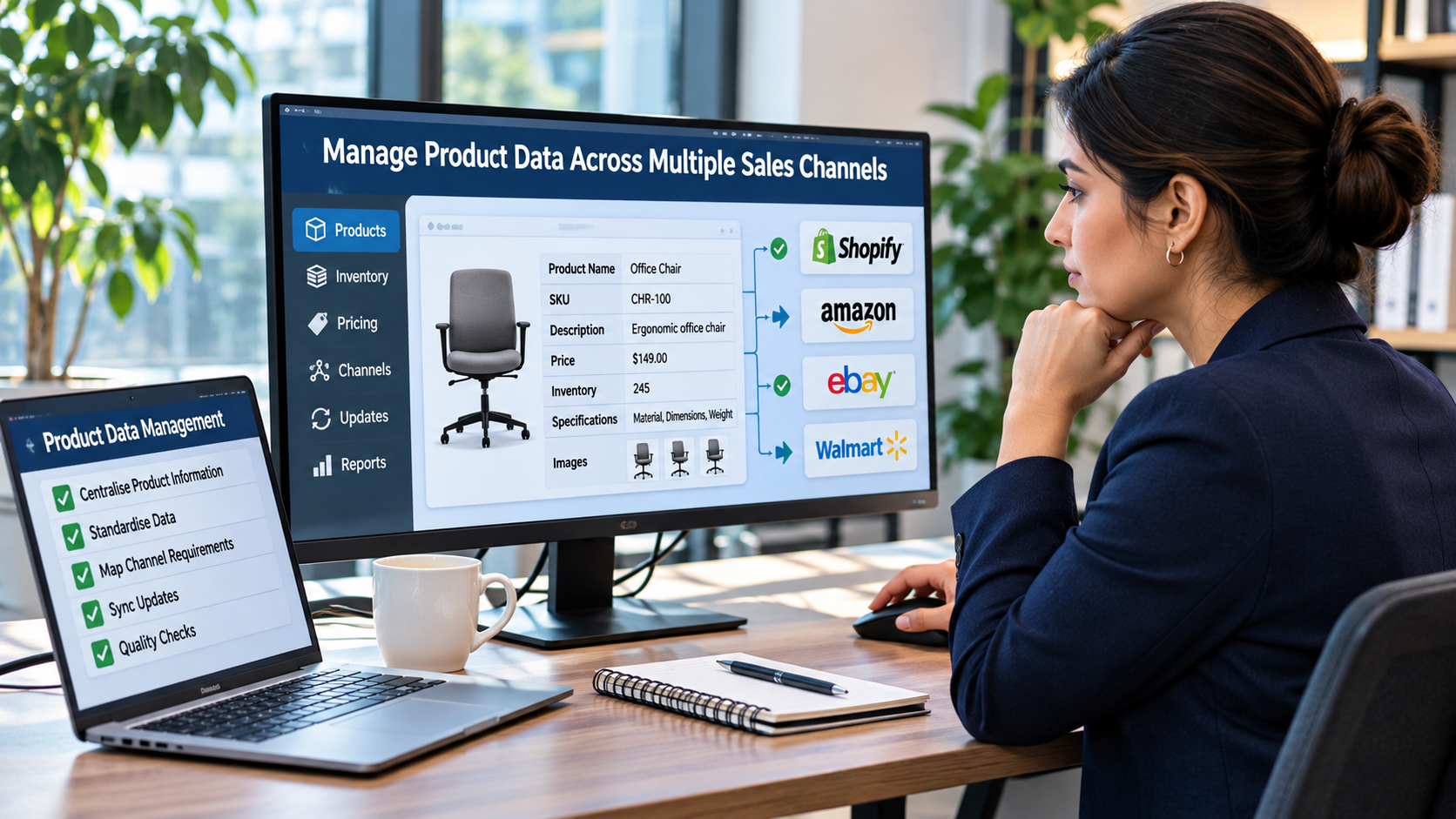
However, multichannel selling introduces additional operational work. Product titles, descriptions, images, pricing, stock availability and product attributes must be maintained across different systems.
For example, a retailer might update a product specification on its Shopify store but forget to update the corresponding Amazon and eBay listings. This can create inconsistent information and unnecessary customer service issues.
Businesses should establish a central source of approved product information and define how updates are distributed to each channel.
Our related guide explains how to maintain product data across multiple sales channels and reduce inconsistencies between online stores and marketplace listings.
7. How to Decide Where Your Business Should Sell
Before choosing a channel, evaluate the following factors rather than making the decision based only on competitor activity.
Step 1: Understand where your customers shop
Identify the platforms your target customers already use. Research competitor listings, customer preferences, search behaviour and product categories.
If customers regularly use Amazon or another marketplace to compare products, establishing a marketplace presence may be worthwhile.
Step 2: Calculate the actual cost of each sale
Compare the complete cost of selling through each channel.
For marketplaces, include:
- Referral and selling fees
- Fulfilment and shipping charges
- Storage and handling costs, where applicable
- Marketplace advertising expenditure
- Returns and other selling-related expenses
For your own website, include:
- Website platform and hosting costs
- Payment processing charges
- Customer acquisition costs
- Website maintenance and development
- Shipping, fulfilment and customer support
Calculate the contribution margin for each channel after variable selling costs. This gives a more useful comparison than looking at revenue alone.
Step 3: Assess your marketing capabilities
If your business has a strong SEO strategy, an established social media audience or an effective advertising team, your own website may have a better chance of attracting customers.
If your marketing resources are limited, marketplaces can provide an alternative route to product discovery, although marketplace visibility may still require advertising and listing optimisation.
Step 4: Evaluate catalogue complexity
Businesses managing hundreds or thousands of products should consider how product information will be organised and maintained.
Different sales channels may require different product attributes, image specifications, categories and listing formats. Your operational setup should be capable of supporting these requirements without creating unnecessary duplication.
Step 5: Test before expanding
Rather than launching every product on every channel simultaneously, start with a selected range.
Measure sales, advertising costs, returns, contribution margins, customer acquisition and operational workload. Use these findings to decide which products and channels deserve further investment.
8. Managing Product Data Across Your Website and Marketplaces
Once a business starts selling across multiple channels, catalogue management becomes an important part of daily operations.
Product information should remain accurate even when different platforms require different listing formats.
A reliable multichannel catalogue process should include:
- Consistent product names and unique SKU references.
- Accurate descriptions and technical specifications.
- Correct product images assigned to the appropriate products and variations.
- Standardised product categories and attributes.
- Regular price and inventory updates.
- Validation of product information before bulk uploads.
- Regular checks of published marketplace and website listings.
For example, a business selling 2,000 home improvement products through its website, Amazon and eBay may need to maintain thousands of individual product records and variations. Updating these listings manually without a structured process can create errors and consume considerable staff time.
Bulk uploads, product data feeds and suitable integrations can reduce repetitive work. However, automation should be supported by accurate source data and proper validation.
Shopify provides CSV-based product import and export functionality for managing product information in bulk. Its official product CSV import documentation explains the relevant process and precautions. Amazon also maintains product detail page rules that sellers must follow when creating and maintaining listings.
Businesses that need assistance with different selling platforms can explore product data management services to support consistent and organised product information.
9. When Should You Consider Outsourcing Catalogue Management?
Managing a small product range internally is often straightforward. However, the workload increases when a business adds more products, variations, suppliers and selling channels.
Outsourcing may be worth considering when:
- Your team spends too much time creating and updating product listings.
- Product information is inconsistent across different platforms.
- Bulk product uploads regularly require additional staff support.
- You are expanding into new marketplaces or international markets.
- Product images, descriptions and attributes need regular processing.
- Your internal team needs to focus on sales, marketing and business development.
Depending on the requirements, businesses can outsource specific activities such as Amazon product listing, marketplace catalogue management, product uploads and ongoing catalogue maintenance.
India Data Entry Services provides eCommerce data support for businesses that need assistance managing product information across online stores and marketplaces. The scope can be discussed according to catalogue size, platforms, data requirements and ongoing workload.
10. Final Decision: Marketplace, Own Website or Both?
There is no universal answer to the marketplace vs own website decision. The right approach depends on how your business attracts customers, manages product information and generates profit.
A marketplace may be a practical starting point for businesses that need access to established shopping audiences. An independent website may be a stronger long-term investment for brands that want greater control over their customer experience and marketing activities.
For many established businesses, combining both channels makes sense. Marketplaces can support product discovery and sales, while an independent website can provide a central brand destination and opportunities for customer retention.
The most important consideration is whether each channel contributes positively to your overall business objectives after accounting for its costs and operational requirements.
Need Help Managing Products Across Multiple Sales Channels?
Expanding across marketplaces and independent eCommerce websites can increase catalogue management requirements. Accurate product information, consistent listings and regular updates are essential for maintaining a reliable shopping experience.
India Data Entry Services supports businesses with product data management, marketplace listing, Shopify product uploads, catalogue processing and ongoing eCommerce data operations.
If your business needs assistance with a large product catalogue or multiple selling platforms, contact India Data Entry Services to discuss your eCommerce data requirements.